I’ve put it off long enough. Today we’re going to talk about banishing, a skill that should be in the toolbox of every occultist, regardless of their beliefs or particular path.
I’m getting ahead of myself though. What exactly is banishing? Banishing is essentially you taking yourself and your surroundings and cleaning out unneeded influences from them, whether those influences be from entities, your environment and the people there, or yourself.
So why would you banish in the first place? As we discussed in earlier blog-posts, most ritualism involves a heavy amount of emotional and energetic output. This is necessary for us to achieve our goals, however these actions will leave a lot of residual energy and emotion around yourself and your environment. Your brain will take a while to come down from the event, and may associate an area with that particular feeling. The leftover energy may also attract other entities looking to feed. While often harmless, their own energetic output and presence will alter the area further, and can cause some strange reactions. A banishing serves as grounding for your mind as well as allows you to clear out all this junk.
Furthermore when focusing on a ritual it’s good to have the energy and area cleaned out beforehand. This will limit the number of influences that can negatively affect your results. Therefore most rituals will have a banishing ritual inserted before and after them. The most common of these for novice magicians is the Lesser Banishing Ritual of the Pentagram, which is a highly customizable ritual designed to cleanse and balance your own energy (the internal component) and enforce and clear out your space (the external component). There is another ritual, which I will not cover here, known as the Lesser Banishing ritual of the Hexagram that is particularly useful for limiting planetary influences. This ritual is comparably more complicated but still easy enough to pick up. There are of course many other rituals dedicated to this area of the occult, but to cover them would be excessive. The rest of this blogpost will be dedicated to covering the most common form of the LBRP and analyzing its use in some detail.
The Lesser Banishing Ritual of the Pentagram
Here I will post the most common version of the LBRP, which is the version I personally use. If some of the symbolism isn’t to your liking, you can look for a separate version. A lot of this comes from a document I prepared for my discord server, which pulls from the additions to the most recent version of the middle pillar book and my own knowledge.
First we should start with the Qabbalistic Cross, which is the following:
1. Stand Facing to the East (if you don’t know which direction that is relative to yourself then just pick one). Imagine a brilliant white light touching the top of your head. Reach up with the index finger (or, if available either a ritual dagger or a wand), and bring it down to the forehead.
2. Touch the forehead and say ‘Atah’ (ah-Tah).
3. Move your hand down slowly, touch the breast, and point downwards towards the earth. Say ‘Malkuth’ (Mahl-kooth’).
4. Touch the right shoulder and say ‘ve-geburah’ (ge-boo-rah).
5. Touch the left shoulder and say ‘ve-gedulah’ (ge-doo-lah). After this, you should be able to imagine a completed cross of light running head to feet and shoulder to shoulder.
6. Bring the hands away from the body and then back together clasped against the breast (as if in prayer). Say: ‘Le-Olahm, Amen’
This cross is performed at the beginning and end of the standard LBRP. The cross by itself promotes health, inspiration, and balance. If you want it’s a good idea to perform the cross fairly often by itself.
The LBRP is as follows:
1. Just as you would when performing the cross by itself, stand facing to the east and perform the Qabalistic Cross
2. Still facing east, with your right hand, use your finger or ritual item to trace a large pentagram. Thrust the finger or item through the center of the pentagram and say ‘YHVH’ (Yode-Heh-Vav-Heh)
3. Turn to the south and trace the same pentagram there, charge the figure as before, this time saying ‘Adonai’ (Ah-Doh-Nye)
4. Do this again in the west. Say ‘Eheieh’ (Eh-Hey-Yay)
5. Do this again in the North, intoning ‘AGLA’ (Ah-gah-lah)
6. Keep the arm extended and turn back to face the east. Extend both arms out in the form of a cross and say ‘Before me, Raphael’ (Rah-Fay-el). Visualize this great archangel of air rising out of the clouds in flowing yellow and violet robes, carrying a brilliant sword.
7. Behind you, visualize another figure and say ‘Behind me, Gabriel’ (Gah-bree-el). See the archangel stepping out of the sea like the goddess Venus, dressed in robes of blue and orange, with cup in hand.
8. Visualize to your right another figure, wearing flaming red and green robes and carrying a fiery lotus style wand. Say ‘On my Right Hand, Michael’ (mee-kai-el).
9. See another great archangel on your left, rising up from the vegetation of the earth in robes of citrine, olive, russet, and black, holding stems of ripened wheat. Say, ‘On my left hand, Uriel’ (Ur-ee-el).
10. Say ‘For about me flames the pentagram, and in the column shines the six rayed star’. Visualize a hexagram (the six rayed star) over your spine, at or slightly above the breast. It’s fine if you see it in front of you, at the back of you, or both, but it must be close to you and within the area the pentagrams have essentially formed.
11. Repeat the Qabalistic Cross.
Analysis
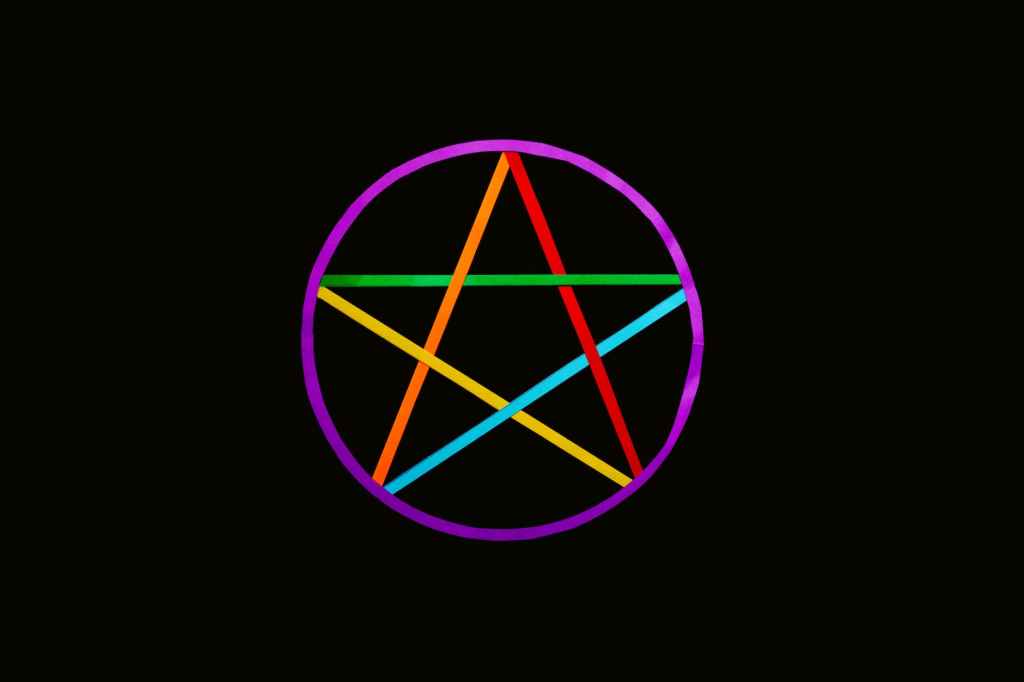
I could go on for pages and pages about the symbolism of the pentagram and the symbolism within the LBRP. I know no one wants to read that so we’re going to keep it relatively simple. The pentagram is a five pointed figure. The most obvious connotation one can immediately draw is to the sefirot geburah, a sefirot of severity, strength, and willpower, which has the number five. The five points can symbolize the four basic elements: fire, water, air, earth, and also the fifth element, which I’ll just refer to as spirit. The upright pentagram (your pentagram must always be upright) represents the control and mastery the element of spirit has over the other four, as Levi argued. The six rayed star at the end (which is a hexagram), represents stability and balance being made from the alchemical symbols for fire and water harmoniously together, which is a critical component of the internal balancing the ritual does. The angels naturally represent the four elements. Note that I have actually given the sword to Raphael and the wand to Michael here. If you see a sword as more fitting for fire and a wand for air, you can swap these, though the style of wand that should be imagined becomes a caduceus wand rather than a lotus wand. I prefer it the way I wrote it, hence this particular version.
The statements in the ritual pull from the lord’s prayer in the new testament (or at the very least the same principles of said prayer, based on another prayer, the prayer of David in Chronicles 29:1.). This idea is mainly seen in the qabbalistic cross in particular.
So then what can we ‘translate’ this ritual into? The ‘language’ of this symbolism is essentially you stating you wish to invoke the powers of the universe and bring out the powers within yourself through the four basic elements to purge yourself and your surroundings of anything that does not belong, commanding this with your own willpower. As such a lot can be substituted to the user’s taste, though I won’t go into details regarding that here.
What this means for intent is you should be forceful when performing this ritual. You needn’t dip into anger but if there are aspects within or around yourself you particularly want to banish allowing yourself to reach a focused anger can be useful for their removal. Otherwise a calm mind combined with a strong will to remove that which does not belong will do well.
If you don’t like the Jewish symbolism or something else about the ritual there’s a hundred billion other versions of this. You can always make use of holy water, salt, or whatever else you fancy to banish instead as well.
The final note that I’ll leave you with is that if you have something you specifically want to keep around (i.e. your spirit lover), and you’re afraid you’ll accidentally banish them, you can make a mental exception for them. This isn’t something that really ever happens if you naturally want them around since your intention will naturally except them, but it’s an option if you feel antsy about the prospect anyway.
It’s been a long lockdown. The riots have virtually created another lockdown in my area. I’ve managed to make it to a park a few times to help shake off the prison-like nature of this house. If you’re having or have had trouble with the lock-down I’d recommend getting outside and way from anyone you’re staying with if possible. Take it easy guys, we’re about halfway through this year. 2020 was slated as a year of rebirth and it’s living up to its reputation, both in my personal life and in wider society.
If you want to read more, check out the categories down below, and make sure to subscribe to stay up to date with information about Spirit Lovers!


 Spirit Lover Information Hub
Leave a comment