
You’ve seen it mentioned everywhere, and if you’re from my /x/ readership you’ve probably at least seen /div/ threads. As an onlooker or maybe someone asking for reads, you may have been interested in how to begin divining yourself. Then you inevitably run into some stumbling blocks. For instance you might wonder why on earth a pack of medieval playing cards is used to divine the future, or how you’d even get started with them. The more adventurous of you may get a pack yourself and start using them with an internet reference to figure out the meanings of the cards. While this is a good way to get started, you probably also then notice your interpretations are fairly vague and may be questionable in the accuracy department.
And what about those spergs that sit around LARPing then communicate some ‘vision’ they had and use that to interpret the future? How on earth would you even begin to try that? Today I’ll be going a little off the main topic of this blog to focus on divination, and how a new occultist may get into it, specifically in regards to tarot cards and the visualized reading.
The Clairvoyant Reading
The Clairvoyant reading: One of the simplest to explain, and one of the easiest types to get wrong. Frankly this shouldn’t come as a surprise; when you’re doing tarot, or I ching, or runes, or throwing a fresh turd onto the ground and interpreting the splatter like some magical shit flinging monkey, you have to at least come up with something coherently related to the results from your tool of choice. When your tool is your mind and visualization ability that means that any moron can sit there and tell you whatever comes to mind. More than a few people have given out bad readings using this method, because it’s easy to believe you can do it and hard to know when you’re doing it correctly.
This method is based entirely on three areas of activity: Energy Work, Visualization, and Interpretation. Interpretation is relatively self explanatory and common to all areas of divination, and going in depth on interpretation for clairvoyant readings would basically turn this blog-post into an exploration of symbolism. Literally no one wants to read that, not even me, so we’ll simply be focusing on the method behind the energy work and visualization side.
There are frankly a lot of utilized methods for this sort of reading, because it’s up to the user’s understanding of visualization and energy work. One man’s visualization will not necessarily work as well for another man. I will still provide the way I do it, but there are some key principles we can point to first regardless of the method. Number four is also true for tarot.
1. You must avoid disturbing the flow of the other person’s energy to the extent possible. While a small disturbance will likely be instantly corrected by their energy body and thus go unnoticed by them, it will immediately affect your reading. If the disturbance is bigger than that you may as well throw out the whole attempt. To avoid this you generally want the method to work with their flow of energy rather than against it or forcefully.
2. All of these readings will be presented to you in symbolism within the visualization. You may see weird stuff. Don’t immediately jump to extreme conclusions based on some of these. Focus on the big picture and the story the symbols may present.
3. Your mind should be as clear as you can possibly get it before performing a clairvoyant reading, so as to limit the chance your own thoughts can muddle up the reading.
4. As an advisory if you’re in an energetically busy area, you can become ‘energetically confused’, which will cause you to report very wrong readings because a bunch of outside energy is in the mix. This is a problem you see run into on /div/ a lot due to the volume of the readings. This is avoidable by being mindful and focused in most cases, or by banishing.
5. Try to limit the personal biases you have about the person’s situation and question, if you have any, during the reading. they may be useful for the interpretation later. This is mostly a problem when reading people you’ve known for a while.
As a result, whichever method you choose to use should keep these principles in mind. With all that being said, assuming you all have at least a working understanding of Visualization and Energy work (and if you don’t, I’ve written a little on the topic in The Early Stages), then you can give this method a try. If you have trouble with this method after trying it for a while, you can try looking for another one or making up your own.
1. Meditate and clear your mind, bringing it to focus on the other person. Ideally you’d banish beforehand to limit the interference of any outside energies.
2. Like we’ve done on the other exercise with your’s, you need to be able to visualize their energy/’aura’. You can do this by focusing on them and using your mind to visualize yourself in a space with them and then following the ideas presented in the other post.
3. Notice the way their energy is flowing. Keeping this in mind, take a specific flow point (ideally one from an area that is symbolically most related to their question for the reading) and let it flow through your ‘head’ or, if you prefer, through an apparatus in front of you, like the area behind an envisioned doorway, or a television, or something, ensuring the flow isn’t adjusted in a forceful manner and is simply harmlessly moving through. This will ensure the energy flow isn’t disturbed while you interact with it as it will still flow normally, with your mind or apparatus simply ‘observing’ it. This could be thought of sort of like surrounding a river with cameras, as an example, letting you observe it without affecting the flow of the water.
4. Let the images come to you, either by letting them appear on the ‘TV’ screen or over the visualization or, if you prefer, by stepping through a doorway ‘into’ the vision, or whatever other way you can think of. Remember that you are a passive observer in these readings, and you should not interact with things within them unless it’s obvious that you should (i.e. someone you can tell you should ask a question, or a door you know you should open, etc.). Engaging in a lot of agency during these readings will add your energy heavily into the reading via the exercise of your will, which will affect the results. If you’re ‘attacked’ during it this is likely related to the symbolism as well, so don’t try and defend yourself, it is after all just a vision. If it’s to the point it’s actually bothering you you can always step out and banish and explain the problem to the other person.
5. Once the experience is over, leave in the same way you came, then detach from their energetic flow. You should also perform a banishing, though this should wait until after the interpretation or at least note taking so you don’t forget any details.
This is more or less the method I use. With some practice you can make it work for yourself as well. Note: there is a grand misconception some users have that something like this counts as astral projection. It isn’t, not even close. As a rule if your body is conscious during the event, you aren’t APing.
Where Card Counting Isn’t Useful
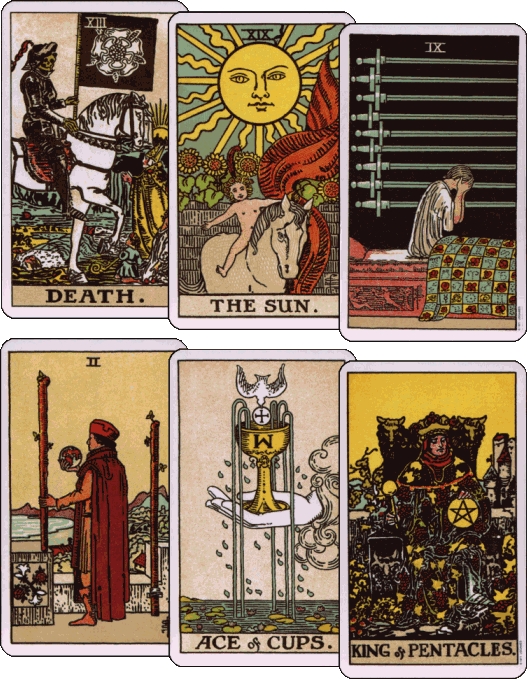
I actually used an image today. I bet the algorithm loves that. Too bad the stats say that none of you read this post anyway.
In any case, next up is Tarot, the most popular divination tool in the west and also one of the easiest to pick up but hardest to master. Besides their origins as cards used for games, Tarot is specially used as a tool for divination. A single tarot deck has 78 cards, which effectively double if you reverse the cards (which I don’t actually recommend, but more on that later), and these can be drawn into any spread, of which there is theoretically an infinite number. This is even discounting the fact there are different Tarot decks, which all must be read differently. Therefore the diviner can both choose the perfect ‘tool’ for his situation on two counts: the deck selected (though this is only something to worry about if you buy up tarot decks like steam games during a summer sale), and the spread selected.
So that’s great and all, but with so many decks and spreads how the fuck does anyone get started? Let’s start with deck selection.
Your first deck should be the Rider Waite or Radiant Rider Waite deck. These are both virtually the same, with the latter having what I would consider better art. Go with whichever one you prefer.
‘But dumbass, didn’t you just tell me choosing the correct tarot deck is very important?’
Yes I did. But you don’t know what that is. You won’t know for a while which decks are good for which readings or which ones you like in particular, and you’d be really stupid to go buy half a dozen decks without even knowing if you like tarot yet.
So then, why the Rider Waite deck? It’s fairly simple. Many decks have the Rider Waite symbolism as their original basis that they then remix to some extent, either with some of the cards or just in general, and even ones with noticeably different artwork often try to theme the cards symbolically in a comparable way. The 2 of cups from the Rider Waite set will directly inspire the meaning of the 2 of cups in most other non-ancient decks that you’ll run into, for example. Most internet tarot searches will also give you meanings for these cards specifically, if you don’t just use the booklet that comes with the deck that also does that, which is useful if you want to study specifically the traditional meanings of the cards.. Most decks that intentionally don’t lean towards the Rider Waite set of symbolism are also harder to pick up in comparison to ones that do, so they’re only good choices to try and learn after you’ve gained some experience. By using the Rider Waite deck first you are essentially preparing yourself to adapt to other decks a lot more easily.
The deck is also just generally widely applicable and easy to work with. All of the artwork is absolutely chock full of symbolism, and once you step away from the traditional meanings and start actually interpreting the cards in the moment you can get a ton out of them. When you have worked a lot with it you can then branch out to derivatives and see if you can figure out the prime differences that set them apart. Finally, the Rider Waite deck is just really good in general. There’s a reason it’s what directly inspires the meanings behind most other decks made these days.
Alright, so let’s discuss spreads. The short of it is that my advice here is the absolute opposite of what it was for deck choice. You should try out a bunch of different spreads. There are some standard choices that are good to learn, such as the Celtic Cross (a ten card spread), the Past Present Future and Situation Action Outcome 3 card spreads, and the 5 card cross-like spreads in general, but remember that you’re aiming to experiment so that you learn to interpret cards in a lot of different situations. Come up with your own even, being able to make up a spread on the fly for a specific question or intuition is actually a really strong skill and frankly makes tarot a lot more fun. You can find a ton of spreads googling them on the internet at first, and once you’ve experimented with those, you can try out that spread you thought of that’s shaped like a particularly crooked airplane.
Alright, the last thing we’ll discuss will be some words on interpreting tarot. While a Clairvoyant reading is very clearly a story that should be interpreted symbolically, we do need to set out some guidelines on how to interpret tarot so you’re not just robotically googling card meanings, which is both boring and useless.
Get Off of Google
‘You stupid Author’ You say, ‘If I don’t know what the cards mean, how can I interpret them?’.
There is value to the definitions of the cards in the booklet or online. This value is only in research. You should look up what cards mean, so you get a general idea of the archetypes, ideas, and energies each one reflects traditionally, and how the symbolism in each card communicates those things. But this isn’t helpful in a specific reading. If you interpret cards by googling their meanings you’re going to give off a lot of vague, useless readings.
Every tarot spread tells a story. Similar to the story of the 22 major arcana and the movement of the fool to the world, every spread gives you very specific information. Let’s take the Situation, Action, Outcome spread as an example. Assume someone is asking you how they should get a promotion at work. I’m going to draw three cards from the RRW deck in front of the screen right now and interpret them as if I was asked this question.
I drew the Seven of Wands, the Four of Cups, and the Eight of Wands. If you googled the meanings of these cards, you’d get the following (based on the first google result, which is some place called biddytarot, in each case):
7oW: Challenge, competition, protection, perseverance
4oC: Meditation, contemplation, apathy, reevaluation.
8oW: Movement, fast paced change, action, alignment, air travel
These interpretations open up several questions. Why would someone want to be apathetic if they’re defending themselves? Does movement refer to upward movement, does it refer to changing jobs, does it refer to air travel? What even are they protecting, are they trying to protect their job, their financial situation, or their chance at promotion?
However, when taken together and studied, these cards can tell a more coherent story. The Seven of Wands and the Four of cups here in particular go together, as do the 7 and 8, letting the seven of wands sit as the focal point of the journey here. In the RW style deck, the seven of wands is a man standing atop the high ground defending himself from attackers below. He is in a good position but he can not cherish it, he has to hold onto it against several attackers pointing up sticks at him from below (these sticks are the wands, but they look like sticks in the pictures, so I call them sticks). This works with the four of cups. In the four of cups the man is offered a cup with three others laying in front of him, and the look on the man’s face is one of dissatisfaction despite being basically handed whatever he wants on a silver platter.
With these two cards we can likely pinpoint the crux of the problem from two perspectives. First, the exterior perspective. The man is in a favorable position already within his job. Furthermore, the man is being challenged by those ‘below’ him. The man here would likely have a sort of lower management role given this information, one that gives him some power over others but not so much they can’t touch him, and may have received it despite protestations from his fellow employees. They’d want to hit up at him, and despite it being given to him, these doubts would weigh down on him. Is he really worthy of the job he got, maybe even having gotten it very easily? Is he worthy to even think about being promoted or to stay in that position? He likely doesn’t believe he is. So he’s stuck in a cycle of dissatisfaction caused both by himself and other people.
This is where the action of the four of cups can come in, the consideration inherent in the man. The man needs to come to terms and peace with these things mentally. His enemies likely won’t go away instantly, after all they may feel cheated out of a promotion or are using him as a target. He shouldn’t ignore his underlings, but he should put their protests into context and perspective, and work on the way he views these things. The result of this may not be a promotion, but a new understanding. The employees may not actually be mad at him, but just using his promotion as an outlet for other issues either at work or in their personal life. This is then supported by the next interpretation. The eight of wands would be interpreted in a completely non traditional way due to the way we can relate it to the seven here. We see many sticks in this picture pointing diagonally upwards, but unlike the men we assumed were below them in the seven, we can see there are none holding them here, the enemies in the seven being imaginary if considered from the perspective of the eight. This would represent him seeing them as his enemies when really he was just a convenient target, and that through contemplating and understanding the issues of his employees, he would discover he didn’t have so many enemies after all, and likely be able to discuss things with them and help them deal with their issues, both saving himself as a target and them from whatever trouble they’re having.
Notice we answered a completely different question in this case. The truth of the matter is that with a reading result like this, the man probably isn’t concerned about being promoted, he’s using that question as a sort of fake wall to consider this other situation or question. He connects the idea of being promoted with security, so the question was really about security and how much he deserved the job, which are linked together. The outcome would be to explain to him to take the words of his employees to heart and try and understand them, and that he does deserve the job, if he’ll only look at it in another manner.
Here not only did we interpret the cards more deeply, but by viewing them as a connected story, we even completely broke the traditional meaning of the eight of wands. This is something you’ll learn to do with experience and knowledge of symbolism. Sometimes a card in a different context can mean something entirely different than it does traditionally. Here we just noticed the lack of people on the eight of wands and compared that to the seven, and used that to produce an idea.
There are of course other ways this could be interpreted, and the way you’d decide on such things is normally down to your own intuition. Here there’s none of that because this reading isn’t for anything other than this blog.
Finally, let’s quickly discuss why I don’t recommend reversing cards. Every tarot card is a beautiful picture that tells a story, and they tell specific stories together in the different spreads based on the spread and the cards. Each image is chock full of symbolism meant to communicate several, sometimes unexpected ideas.
So what does reversing them even do? Reversing tarot cards in most decks is a product of that robotic mindset, the idea cards have a set meaning. You reverse a card then suddenly it’s different? Even though the art and symbolism doesn’t change? It doesn’t make any real sense. It only does if you’re interpreting cards in the most robotic way possible, which is something you should learn not to do. The only exception is if a deck has art that directly encourages the reversing of the cards, so you get an entirely new picture when a card is reversed. I have yet to see a deck that does this, but I imagine one exists.
That about covers it. Divination is a wide topic and certainly not limited to these two kinds, but we’d be here all night if I dragged in Runes, and I ching, and bowls of water, and so on. If you’re at all interested definitely give it a shot, especially tarot, which is a lot of fun. Though not covered here, tarot can also be used for symbolism during rituals, and naturally it’s another option for spirit communication before telepathy.
I hope you guys have been doing well. Part of my desire to make a post about this was because I haven’t been able to do readings lately. It gives me another outlet for that sort of itch. Stop by if you want one. If you don’t believe this post proves I can do a good reading, you should let me prove it to you myself.
If you want to read more, check out the categories below. Make sure to subscribe to get the most up to date information about Spirit Lovers (and, I suppose, going by this post, other things occasionally)!

 Spirit Lover Information Hub
Leave a comment