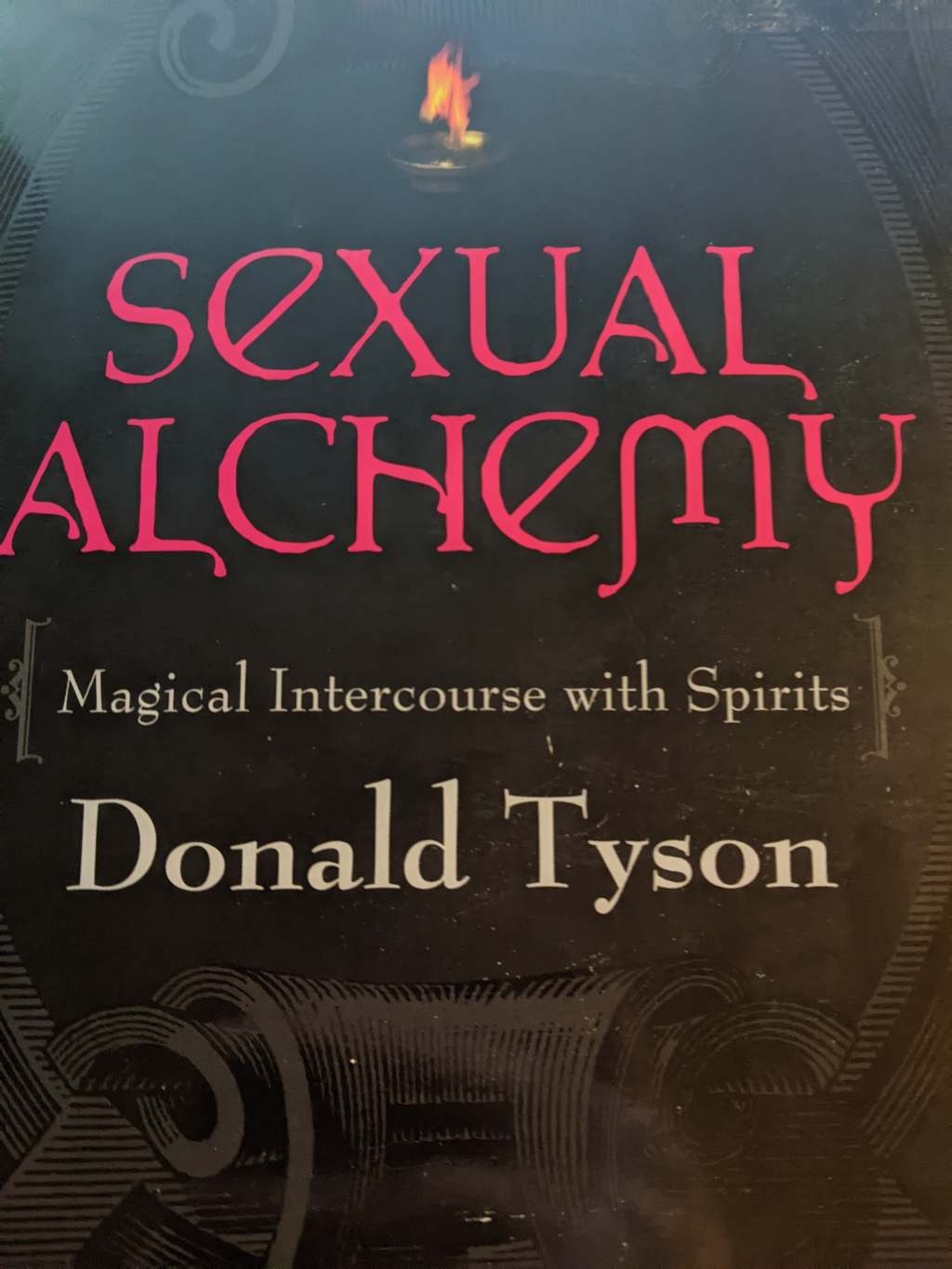
Donald Tyson is an author that I have mentioned a few times on this blog. He wrote Liber Lilith, a book that was mentioned in the Interview with Tim. In that blog post and in the post about the Yukshee, I was very inclined to give Tyson the benefit of the doubt. The scholarship in his rendition of Agrippa’s 3 books was very good, and that’s how I knew him. Therefore I projected that scholarship onto his other works, assuming they would be well researched and well argued. After all, someone who can do the level of research Tyson commonly does is typically assumed to be a person who could make effective and intelligent arguments in support of his points. However, I couldn’t ever be sure if this assumption was correct, because Tyson isn’t making arguments within Agrippa, he’s just offering extra background information with his annotations and a foreword. Tyson was a younger person when he wrote Sexual Alchemy, but he was still well into his 40s, so I didn’t expect a huge drop in quality over the decades.
I had always wanted a copy of Sexual Alchemy. It was one of the very few books that purported to talk about spirit relationships that I knew about. The topic is generally pretty niche, so I saw Tyson as a bit of a pioneer in the field, and often wondered why the book hadn’t taken off. It was only very recently that I managed to get my hands on a copy, having found it at a good price. I was very excited for the insight he might bring to the discussion.
So, what did I think? Was the book any good? Should we base our community efforts on some of the ideas within the book? Why was the book mostly forgotten, and ultimately, should it stay forgotten, or be brought into the mainstream?
The Good: Description and Scholarship
As stated in the intro, if there’s one thing that Tyson does well, it’s scholarship. Tyson is a man that I have always described as very much book smart, and that trend is absolutely present here, within Sexual Alchemy. He’s able to cite many mythologies, legends, and worship practices from different cultures, and just reading those stories and citations, outside of his arguments, is a treat. The infamous ‘Yukshee’ transliteration excepted, it’s very interesting to read about the various worship practices in particular. This is setting things up for later in the book, as the practices he later talks about are almost always coming directly from the idea systems from the first half of the book. Tyson’s understanding of these phenomena are very much filtered through the lens of what he understands.
In the first half of this book, he spends time discussing concepts and practices like Tantra, Internal Alchemy, and the alchemical Homunculus. He shares mythical or historical anecdotes relating to these factors, and these anecdotes are by themselves very interesting. He generally tries to use this ‘evidence’ to support many of his stances, but we’ll talk about that later.
The other thing I would like to point out as an abject positive within the book is the 17th Chapter, which he titles the Physiology of Spirit Sex. In this chapter, rather than actually speak about what we’d normally consider physiology, he shares a lot of the experiences he and the people he has spoken to have with these spirits. He describes the sensations, some of the various visual and tactile phenomena, and so on. For the most part these descriptions are very accurate to my experiences and the experiences of people I have dealt with. In fact, I was honestly surprised at some of the phenomena he mentioned, as they were ones I would think about and share with people less often, such as the white flashes or the other light-based effects that these entities can create. I normally shy away from sharing these descriptions with people who have just begun their relationship, as I want to see if they experience the same things without being told beforehand what those things are, but if you want a very accurate accounting, if a bit upsold in some cases, as to a large set of the phenomena that one will usually experience within these relationships, then this chapter has you covered. If there’s anything we can say about Tyson’s experiences with a spirit lover(s), based on what he has shared in that chapter, they do seem real and very well defined and described.
He also talks about ritualism in the second half, for many different purposes. I have less to comment on this, as we all know that I take a very psychological viewpoint to ritualism, meaning that different rituals can work for different people, even if they seem oddly designed. Tyson doesn’t revolutionize anything, given he’s staying within the lanes of his preferred practices. Most of it is coming from other sources, such as the chapter on the Middle Pillar, and a lot of the practices feel grounded in a more ritualistic and religious practice that is faithful to his background in Eastern and Golden Dawn practices. Suffice it to say that there are many places where I disagree with him, and many where I agree with him, as to the ritual approaches he uses in some parts of the book, and my agreement or disagreement is generally not that relevant except in extreme cases when it comes to ritualism. Your mileage may vary based on your personal belief system.
The Bad: Arguments and… Political Soapboxing?
Without a doubt, the problems with this book are mostly apparent whenever Tyson tries to relate his citations to the points he wants to make. Within Sexual Alchemy, Tyson has an unending tendency to interpret things in what I would describe as the ‘most convenient’ way. What do I mean by this? Most mythologies and religious practices are written to be understood within that practice or mythology, for obvious reasons. That context is the key to understanding what those practices were talking about, and then relating them to each other based on those discovered understandings. If you don’t do this, the belief system isn’t being given a fair shake, instead being co-opted for your own argument or world view. It is a very convenient way of looking at them, because it can only serve you. Tyson loves to co-opt anecdotes, stories, and historical information by interpreting it in whatever his preferred way is, electing to ignore mainstream, dissenting, or sometimes blatantly obvious interpretations. At most he’ll acknowledge they exist before quickly shuffling to his point. This means that Tyson comes off more like a salesman that wants to make you think like him, rather than someone actually trying to fairly represent the topics in the book. It makes you immediately skeptical towards everything within the book, so that when you do find useful information, it loses a lot of its impact, because of how dishonestly so many other points are handled.
One of the most obvious missteps he makes early into the book is in his reference to events at medieval trials. You know the ones, they torture you until you start admitting to depravity, then execute you for said confession, which seems like sweet release after the torture. He uses these confessions twice in the book. First to claim that witches were having sex with Satan (which at the very least doesn’t come off as much of a leap), then with the templars, who he claims were engaging in homosexual ritual magic. These claims are all based on confessions made under the duress of torture, meaning they are very unreliable. Despite this, Tyson implements these supposed practices into the wide brush he’s trying to paint with sex magic. I find it particularly odd that he’d take these catholic trials at their word given the clear distaste he has for Catholicism (and pretty much any belief system that isn’t ‘sex for pleasure good’) throughout the book. A marriage of convenience, perhaps?
He also has a tendency to make claims that are just ludicrous. Also early in the book, he mentions that poltergeists are generally accepted by ‘parapsychologists’ to be succubi and incubi that are acting up near people who have usually recently hit puberty. Which parapsychologists? What proof is there that these things are even related? Is the argument here really that most poltergeist activity happens near teenage boys and girls, because that doesn’t seem to line up with reality? We know you can cite things Tyson, so why haven’t you cited or at least quoted these parapsychologists? When you choose not to it is readily apparent that the support you allude to is limited at best, or at least it’s easy to assume it is. For all I know that claim could be true or at least popular, but the lacking support in the book makes it very hard to swallow. Another example of a claim he makes is in the following picture, from much later in the book.

As another example, in the next chapter he begins comparing the witch that cavorted with Satan to Saint Theresa. He notes essentially that the Christians saw one as great and the other as bad, which is very obvious. He claims there’s no material difference between the two, saying the mark each received is evidence of their marriage to a spirit. There is no argument for this, that’s just how he says it is. He then goes on to show that other religions make the same distinction, but contrasts his personal viewpoint: that sex for pleasure is okay and therefore all these acts are equivalent and none bad.
Regardless of your personal opinion, is it not obvious how ridiculous it is to try and equalize all these things? The sexual practices he relates in this book that are taken from other religions and mythologies are always within a specific context; normally they’re either a form of worship or ritual, or they’re somehow related to what the people experiencing them would call a divine experience (Tyson has to stretch his interpretations of quite a few stories to try and relate them to sex). This is the complete opposite of sex for pleasure, and the reason that the mainstream interpretations of these religions take issue with casual pleasure-based sex is entirely because of that dichotomy. When sex is in a worship context, they view it as placing it on what is essentially a divine pedestal. Therefore, if that sex was sought even partially for pleasure, the divine nature of the act was being robbed, because the participants intention was self serving, which is in direct conflict with the all encompassing nature of divinity from a human perspective. Despite his insistence to the contrary, intentions very much do matter. So no, we can’t equate these two, or most of the practices within the book that are shared to Tyson’s sexual worldview, as Tyson so desperately wants to. He rips these practices out of their proper context and tries to force it to fit his modernist worldview. These practices are not the same when outside of that context, performing them for the sake of pleasure is the same as not performing them at all.
For the sake of brevity, there is only one more example of this I want to cover. In the Homunculus chapter he discusses the medieval legend of the Golem. To give you the cliff-notes, a Christian priest wanted to destroy a Jewish Ghetto; a very popular sentiment in the middle ages. Rabbi Loew, a master of the name, had a dream where he received instructions to make a golem using various god names that he was able to make with the phrase he was given in the dream to protect his ghetto. This is very standard stuff in Jewish mysticism: Jewish creation philosophy and magic very much revolves around the Jewish alphabet. They actually talk about what would go into making a golem in my copy of Sefer Yetzirah, where the author asserts that if such a thing is possible, it would take hours of meditation focused on specific body parts, combined with perfect recitation of the language in very specific ways. If you read that and then read the legend, it’s very easy to connect the two, as even though what they do in the legend isn’t exactly the same as what they talk about in my copy of SY (at least based on Tyson’s telling), the actual function of using the Jewish language to perform a magical act is the same.
Tyson then deigns to give his opinion on what they must have done in this ritual. He claims it would have possibly been necessary for them to urinate onto the clay to soften it (despite being on a riverbank?). He claims it would also be necessary for them to masturbate into a cavity in the golem’s body, probably its mouth, despite Jews being strictly forbidden from masturbating according to most Rabbinic sources. Most shockingly, he claims that it would be necessary for them to infuse the clay with menstrual blood. Handling menstrual blood is explicitly stated within the Torah to make you ritually unclean. Tyson knows this as well as I do, after all he was referencing the bible on the very same page that he made this wild claim. Does it seem likely that within a Jewish ritual they would perform actions that would make them ritually unclean? Does it seem likely that someone that earned the title “Master of the Name” would use masturbation in a ritual? No, it doesn’t. Let’s not even talk about how he tries to misconstrue the legend to make it fit with his idea of a homunculus.
In trying to tie what often feels like everything into sex magic or sexuality in some way, Tyson errs an innumerable number of times throughout the book. His arguments are so bad that one goes from disbelief to howling laughter in some cases. The occasional fits of laughter the book sent me in to did make it exceptionally easier to get through the book. What didn’t was his endless soapboxing.
Let me be clear, the man’s politics aren’t what bothers me. The fact that he so often has to spend time whining about patriarchy and misogyny in a book that is supposed to be about occultism, however, does. It seemed like every time I would forget about his political soapboxing for a few minutes, I’d have to get slapped with some statement about the venom he has for patriarchy, or how the church is misogynistic, or so on. It was a downright pain in the ass every single time.
Conclusion: More Tyson than Spirit Lover
To be frank, this book is so all over the place, so poorly argued, and on occasion so in your face politically that I honestly struggle to say that it is truly about spirit lovers. He does such a poor job of relating most of the things he talks about to truly intimate spirit relationships, and spends so much time talking about myths and talking about religions and talking about things that are just normal occult rituals or practices (the middle pillar for instance) that he then usually poorly relates to spirit relationships, that I would argue this book isn’t, at its heart, about spirit lovers. It’s really just about Tyson vomiting up his personal politics, his religious studies, and so on for a good 300+ pages, as he struggles to make any of it relevant. It’s Tyson trying to sell his worldview, like a used car salesman, more than Tyson doing a good job explaining spirit lovers and the relationships people try to maintain with them.
What this book doesn’t give you is a balanced take on the subject of spirit lovers. One of the things this blog has set out to do that this book fails to do is to focus on the development of a relationship with a spirit lover, from first contact to the long run. The ritualistic approaches sometimes shared within the book may be useful to some readers, and the experiences he cites within the physiology section are very interesting, but is that worth slogging through the entire book for? No, not at all. The 17th chapter can’t carry the whole book, especially with everything that drags it down. I wouldn’t recommend the book to anyone other than the most curious. At the very least the prose isn’t overly wordy like so many occult books are, which means getting through the book isn’t a complete chore. The mythologies, religious information, and other referenced information can be interesting, and that’s really about all.
It’s honestly no surprise the book is so expensive and hard to find. The reason it didn’t create a spirit lover renaissance or a huge audience is simply because it’s not a very well thought out or well argued book. I don’t think Tyson is an idiot, it’s clear that even in 2000 he was very well researched. It’s just that the book is all over the place and does a very poor job of delivering on its premise. Tyson tackles subject matter that is too widely separated and often only tangentially related, his arguments are very often hand waved or ill supported (sometimes to comical degrees), and his personal politics rear their ugly head just often enough to take you out of the book every single time. He would have been better off discarding his weaker arguments and focusing down on the core of the book without bringing in way too much outside stuff.
So, it’s been a while since I’ve made a blog post. That series that I started in December is still in the back of my mind. Many of you may have wondered what I’ve been doing, and if I really care about the blog any more. Simply put, I’ve been writing my own book in my spare time, rather than writing as much on this blog. There’s really no other reason for it; I’ve simply been using all my writing energy on that book rather than on this blog. The book isn’t anywhere near completion, but I’m thinking I can finish a vomit draft by the middle of the year. I wrote this blogpost because after reading SA, I really just couldn’t help myself. There will be more posts, just not as frequently, at least while I’m working on my book.
IMPORTANT PSA:
I have been told that someone is pretending to be me on Discord. I’ll make a post specifically about that if I get more details, but for now, I should make something clear. I do not have an account on discord within any occult servers, including the one that I used to own. I naturally don’t check them, I don’t ask people to check them, and I don’t know what goes on in them. If you thought you met me through a server after my blogpost about leaving went up, that’s not me.
If someone claims they are me on Discord or anywhere else, they are almost certainly not me.
If I try to contact someone on discord you’ll be able to verify it’s me using something like this blog or like my steam account. If you NEED to talk to me, you should ask the owner of the server I used to run, and you should tell him why you want to talk to me (as well as the account name I knew you by if I knew you). That is the only way you can contact me outside of this blog, and I won’t answer every request. I know there are people who miss me and want to talk to me, and I’d love to get into contact with some of those people, but for now, I’d rather keep things on a case by case basis.
Also, I wrote this at 3 AM. I’ve proofread it as best I can, but if you saw some bad or confusing writing, I’ll inevitably swing back around to fix it in a couple days. As always, feel free to ask whatever or say whatever in the comments. I’ve noticed word-press drops the ball on notifications sometimes, so if I miss your comment, it’s not intentional, or personal.
If you want to read more, check out the categories below. Make sure to subscribe to stay up to date with the newest information about Spirit Lovers!


 Spirit Lover Information Hub
Leave a reply to Are Alternative Practices Useful for Spirit Lovers? – Spirit Lover Information Hub Cancel reply