
Back in August, my friend TC posted an article about the ‘Joy of Satan’ rebranding. This isn’t something I’d normally care about; dealing with Neo-Nazis in the occult is a game of whack-a-mole, and this blog isn’t the space for that.
However, in a move we both found surprising, the new rebrand, known as Temple of Zeus, takes a very hard anti spirit lover stance. This is outlined on their incubus and succubus article (Archive Here), which will be the focus of today’s blogpost.
You may be wondering why I’d take issue with an article like this in the first place. After all, most people and religions are very firmly anti spirit lover. It’s very difficult to hold that against someone who honestly believes in something like Roman Catholicism. They have their viewpoints regarding spirituality and spiritual cosmology and I have mine. It’s natural we’d disagree and I’d never hold that against them.
However, when I was digging into the article from ToZ it became clear that the author was going out of their way to mislead and misinform their audience to attack spirit lovers (and others, but we’ll get there). I find this kind of casual dishonesty highly distasteful. It’s one thing to be wrong, it’s another to mislead people knowingly.
So, today I’m going to dive into this article in detail, and raise the countless objections I have with its content. This blogpost will be sectioned off the same way the article is, responding to each section individually. The introduction and Conclusion don’t add anything addition to their argument that isn’t covered within a section, so we will not be going into detail on those two sections. If we did, it would just introduce more repetition into my objections.
Feel free to open the Archive if you want to follow along to ensure I am being fair to the author. I’d rather use an archive here to avoid giving their website traffic, and to ensure that you have the version I was responding to regardless of future changes. I won’t be quoting everything they say because this blog post is already long enough. Quotes I do use from them are in italics. Several other outside quotations also exist where appropriate, often in their own blocks.
This is a much longer blog post than I normally make, so here’s a TL;DR of my feelings about the article. (clicking [or tapping?] the arrow or this short paragraph will expand this section and others like it)
The author’s arguments are deliberately narrow, often incorrect, and sometimes both of these. This article also has an ulterior motive, and that is to throw shade at Christian Theologians and rabbis, claiming they were and are sexually repressed and delusional.
His understanding of Greek myth is limited, and his understanding of more modern systems of Witchcraft seems almost nonexistent. It is to the point that he seems deliberately ignorant of other systems that include the spirit spouse concept and other definitions of succubi, including within Greek mythology itself. He argues against spirit relationships using the Christian definition of the succubus despite his clear hatred of Christianity. This creates a very narrow argument and understand of what a spirit lover is. Even within this specific area, his knowledge of Lilith and Succubi specifically is quite limited, as his conception of them boils down to ‘an explanation for Nocturnal emissions’. This is already limited when it comes to succubi and incubi, and even moreso when considering the Jewish mythology about Lilith herself.
The article is needlessly biased and hateful towards especially Jews (sadly unsurprising), and also Christians. It is also obviously biased against practitioners with spirit lovers and carries some disdain towards other practitioners as well. His ignoring of the many other systems with succubus-esque or spirit lover based mythology carries with it an implication that his Greek system is superior and that those other mythologies don’t deserve consideration, but I’m willing to chalk that up to ignorance instead of disdain.
The good things that I can say is that his knowledge of Plato is passable within this article, though that knowledge isn’t very applicable to the subject matter. When we actually take the time to dig into the idea and see if a spirit lover concept can fit within it, it becomes clear he’s missed several considerations, but it’s hard to hold that against someone especially if this subject matter isn’t their main focus. I also can’t disagree with his distaste towards the actions of the inquisition and burning times in particular.
He eventually concludes by trying to convince the reader that these relationships are fake and spiritually harmful, and claims the practices within Zevism are superior spiritual practices. His arguments and religion aren’t very convincing to say the least.
Overall, my main issue with the article is how he seems to be deliberately dishonest and hateful in several sections. This hatred is directed towards Jews (the lion’s share), Christians, and other practitioners. There is little of value within the article and what may be of value is not original. It seems designed more to seem plausible enough to someone who doesn’t dig into it while stirring the pot against groups he doesn’t like moreso than it seems designed to be accurate or compelling upon deeper examination.
Section 1: The Ancient World: Plenty of Sex in Myths, Actually
After the introduction, we reach the meat of the article. There are 8 sections meant to build a strong argument against the existence of spirit lovers, mostly aimed at the concept of the succubus. He leads in with his first intentionally misleading sentence:
Let this be stated without qualification: neither Ancient Greece nor Ancient Egypt produced the concept of a daemon or spirit whose primary function was to have sexual intercourse with human beings.
This is a fascinating sentence. Despite the ‘let this be stated without qualification’, it contains within it 3 qualifications right from the get go. The first: a concept. The ‘concept’ of a spirit or daemon would be what we may think of as a ‘race’ or an ‘idea’. Ergo, if there isn’t some equivalent of an ancient Grecian succubus specifically it doesn’t count. Second, that this be a daemon (or Daimon, he spells it with the e here but more often spells it with the i) or a spirit specifically. This qualification isn’t that serious. Third; that their primary function is to have intercourse with human beings.
If you read this and wonder how the author may blissfully ignore such a wide swath of Greek myth, this is why. He has intentionally created such a narrow definition for what counts as a spirit lover that the Satyrs, Nymphs, and Fauns among others are immediately left out. The Greek comic poets would be rolling in their graves. Yet, despite this, I was still able to find what I would consider a valid example.
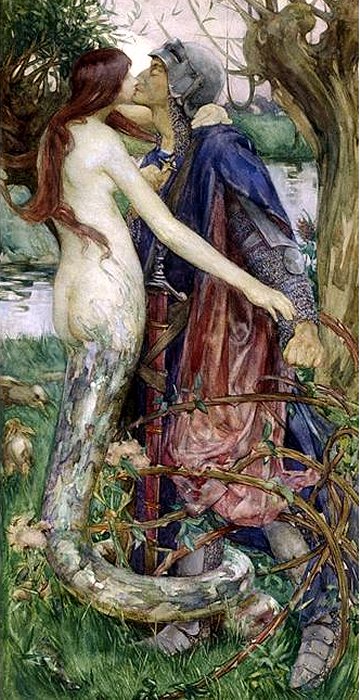


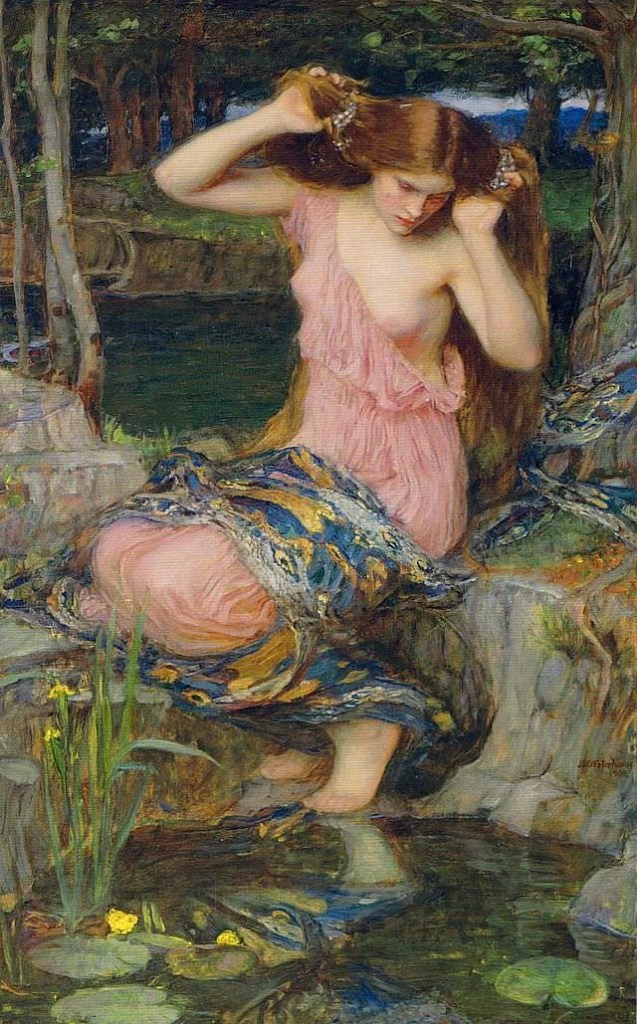
The Empusa and associated Concepts
“THE EMPOUSAI (Empusae), LAMIAI (Lamiae) and MORMOLYKEIAI (Mormolyceae) were fearsome daimones which assumed the forms of beautiful women to lure young men to their beds to feed on their flesh and blood. Behind the illusory facade the creatures were truly demonic–the Lamia had the tail of a serpent in place of legs, while the Empousa had flaming hair and two mismatched legs, one of brass, one of an ass.
Later authors describe the Lamiai as ghosts (phasma) which used illusion to seduce young men. They were companions of the goddess Hekate which followed her to earth from the depths of the underworld.”
Further reading: https://www.theoi.com/Phasma/Empousai.html
I still find it interesting that so many of what we now consider succubus concepts are blood sucking and flesh eating monsters on top of it. The actual succubus seems very relaxed as a concept in comparison!
These aren’t the only conceptions of these specific monsters in myth; myth changes over time, but they are valid ones and striking in their resemblance to other succubus myths. Before this, they would have been singular monsters or names. I enjoy their SMT Designs, hence the art choices, though I’d actually not played P3 before this point, and thus the empusa being in it surprised me. All of the art choices are naturally much newer than the concepts are. Most of these are the Lamia. I’m not immediately sure if the Mormo is close enough to the other two to count, despite what the page says.
>Images Taken from public domain or SMT Wiki. You can probably figure out which is which.
For some additional examples of the concept that exist within mythology when these qualifications are removed, we have Thetis and Peleus, Nomia and Daphnis, Salmacus and Hermaphroditus.
With Zeus specifically, we have Zeus and Alcmene, and Danae, and Leda, and Europa, and Semele, and Ganymede (who was a man, and was only later seen as someone Zeus was sexually interested in, rather than just someone with great enough beauty to be brought to Olympus to be the cup-bearer. You can subtract this one if you want).
Or Poseidon and Medusa in Ovid’s Metamorphoses (if we accept a Roman author). Or Poseidon and Aethra. I could go on, the list of mortal and divine sexual encounters doesn’t stop here.
…but these are theogamies, unions between gods and humans, not demonic predation. The god arrives in glory. The union produces heroes (Heracles, Aeneas). The framing is sacred, not horrific.
The author tries to touch on this idea, saying these theogamies aren’t actually sexual or predatory, but that they are a divine union that produces heroes. Except that they are very much sexual and often predatory. These myths are largely framed as the sexual and lustful pursuit of these immortals. In some cases these myths end in tragedy, and in some they are fairly explicitly assault. Even when they do produce heroes, the myths frame them as sexual encounters brought forth by the lust of the god involved, not in the same way that, for example, the virgin conception and birth in the Bible is framed.
Plato and Socrates themselves, who the author will base some of his arguments off of, were also not huge fans of these kinds of myths because they framed the Gods as fallible. To deny lust and sex as a primary motivator of the Gods, Goddesses, and various mythological creatures in these and other mythical encounters is ridiculous and in disagreement with the source material. It’s one thing to deny or even reinterpret these myths as a part of your personal religious beliefs. It’s another to write them off wholesale as something they aren’t.
The author also mentions Ancient Egypt as an example of a mythological system without mythology reflecting spirit and human companionship. Egyptian kingship was defended as descended from Amun directly, such as in the case of Hatshepsut. The pharaohs were also the living incarnation of Horus during their lives, acting as the God-kings of Egypt and naturally producing heirs while doing so. This was not about lust or sex as much as it is about lineage and legitimacy, but it’s an important part of the mythology. It is obvious that these older traditions did take the sex lives of their deities seriously.
The Mesopotamian tradition does include the lilitu and ardat lili, female spirits associated with wind and desolation, and these are distant ancestors of the later Jewish Lilith. But the Mesopotamian lilitu is a storm spirit, a bringer of disease, a haunter of desert places. She is not primarily a sexual entity.
The author also comments shortly on the Mesopotamian Lilitu and Ardat Lili, which he lumps together as both being the same spirit being associated with wind and desolation (and disease). The Ardat Lili is, however, not the same. Within this we can see that the Ardat Lili was characterized by some as much closer to the later lilim or succubus, though the origins of the spirit are naturally different than the lilim.
That there existed different traditions about the origins and fate of succubi is evidenced by the incantations against the Ardat-lili, which give a different etiology for this class of demons: denied a spouse in life, she seeks one after death, having become as a demon.
As the author tries to conflate the two and only outlines this definition of what a lilitu is, I do wonder if this is an intentional misdirection. It would be one thing if he simply disagreed with this interpretation of the Ardat Lili (and there is space to disagree; our available sources on this class of demon are very limited), but to leave it out entirely and to conflate it with the lilitu entirely seems dishonest to me, even though they are within the same class. I do think that it could easily be an honest mistake instead.
If it isn’t, it’s worth noting that these ancient attributions and interpretations are up for debate, and it’s fine if you disagree with some and agree with others. However, at least acknowledge the other side here. Don’t pretend that this conception did not exist by framing the two as the exact same thing.
Section 2: Plato’s Daimon
The Ladder of Love and Eros
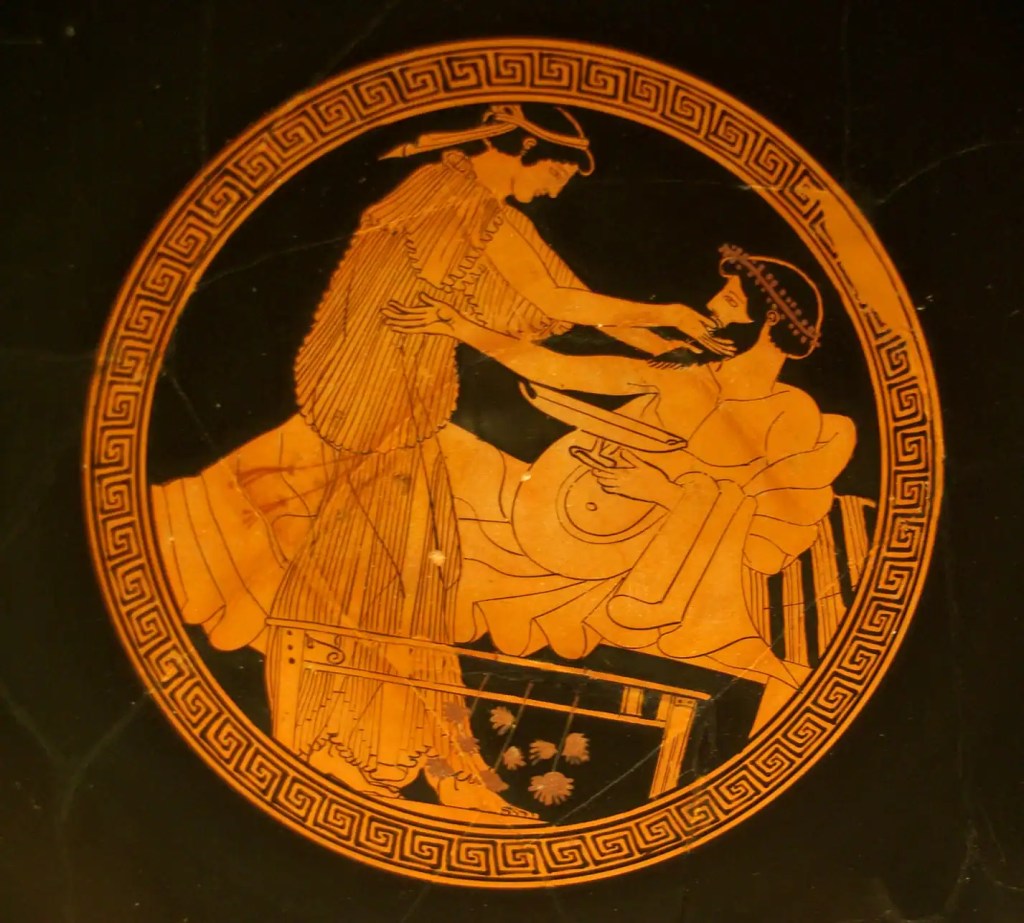
Let’s talk about Plato now. The Ladder of Love is a progressive ascent upwards towards an appreciation of and understanding of an unchanging form of beauty. Indeed, I can’t disagree with the author’s interpretation of what is actually here within this Symposium, because it’s fairly cut and dry. While young you begin by appreciating the beauty (specifically physical) of one individual, which we would probably think of as basic attraction, most usually heterosexual, though it did not have to be. This then expands to include an appreciation of the physical beauty of other people, as you see similarities between them. For example, you may like long dark hair in one girl, and then see it and appreciate it in others. From this you recognize that beauty is present in all kinds of beings, and contains within it certain attributes.
Next we begin to see beauty in minds; morality, virtue, whatnot, regardless of the body they’re within. Aside from being a very convenient rung on the ladder if you’re ugly, this both steps away from physical beauty and physicality and also towards timelessness. While a beautiful mind isn’t immortal and unchanging, it is a step closer to that than physical beauty is, which inevitably fades with age. Institutional and then societal knowledge is also discussed, and in the same way we might recognize that beautiful knowledge within society and institutions will last even longer than said knowledge in an individual (which also steps further away from the body).
Eventually we reach an immortal and unchanging form of beauty, which contains within it every beautiful thing and can not contain anything that is not beautiful. Imagine that you remove the idea of time from the equation altogether, and take every potential instance of beauty – physical, mental, virtuous, etc – and slap it into a bucket. The contents of this bucket are unchanging because it contains within it every instance of beauty that exists. The contents within this bucket also exist outside of time, so they never change.
The eros of this daimon is not sexual desire. It is the soul’s longing for what it lacks: beauty, wisdom, goodness, immortality.
Something that we establish within this symposium and the ladder of love broadly is that the first steps on this ladder do include what we would generally consider to be attraction. Now, if we accept that Plato’s Eros here is in reference to an intermediary force of love and desire (which is accurate) that is intended to bridge us towards this immortal idea of beauty, we can easily point out that such a force would include sexual desire.
After all, without sexual desire and attraction, there is no first rung. We can’t observe our first beautiful man or woman and discover the concept of beauty. We can’t find something sexually attractive beautiful because sexual desire would not exist, and therefore we can’t appreciate that physical aspect of beauty that leads us to more timeless forms of beauty. Or could Eros, a Daimon, not appeal to that aspect of our soul to help us appreciate beauty?
Is Eros only sexual desire? Of course not. But it would have to be inclusive of sexual desire. The immortal, unchanging form of beauty would also be inclusive of the beautiful aspects of sex itself. If sexual desire could lead us towards discovery of those aspects, it would be a part of that intermediary force.
I think that I should also point out that these platonic ‘Daimons’ weren’t believed to be strictly conceptual ideas that we assign a name to. They were seen as intelligences and spirits, which is something we’ll get more into in section 3. As we talk about this idea of Eros, it’s easy to imagine it as just a concept, because that is how we would think of it in the modern day. However, it is a living and active spirit or spiritual force.
Eros in Plato is cognate with Hermes. Both are intermediaries. Both move between realms. Both facilitate communication between the divine and the human. The word ἔρως itself, in its Platonic usage, denotes attraction, longing, desire for completion. It is the force that draws the soul upward. It is emphatically not a euphemism for sexual intercourse with a spirit.
Whether or not Eros is used as a euphemism is not an important question to this discussion, and the use of the term ‘euphemism’ is designed to be misleading. Of course ‘Eros’ is not a euphemism for spirit sex, and I’m not sure who would claim that. People in spirit lover relationships are not using the term ‘eros’ to refer to sexual intercourse with a spirit, and they never have. However, as we have established, Eros is connected to sexual desire just like it is to attraction and longing.
Plato and Socrates were broadly against a large section of Greek mythology, believing tales of fallible Gods were both invalid (as God had to be perfectly good) and bad for society. This, along with his claims of a personal Daimonion, got Socrates the chopping block. Socrates may have been okay with the Grecian Pantheon existing, but it is unlikely he would have viewed most of them as Gods in his conception, or if he did, he would have to reject most of their mythology.
I actually see Socrates’ conception of divinity here as somewhat underdeveloped; he has a very human conception of good and evil, and ordered and disordered, and feels this is applicable to the divine (the divine would only encapsulate the good and ordered in his system), but that’s simply my personal opinion. This is also part of why Plato is so popular with Christians.
The Question to Answer
The important question is whether this philosophy is inclusive of the concept of the spirit lover.
Now, the spirit lover does not have to exist within every single philosophical approach to be a legitimate concept, and I want to be clear about that up front. Plato and Socrates are not the gatekeepers to legitimate spirituality and never have been. However, if we are able to find a place where the spirit lover exists within platonic philosophy, the author’s argument quickly falls apart.
First, we would want to place them. Spirit lovers are not Gods in the Platonic sense, and thus not meant to be beings of perfect beauty or something unchanging and divine. If they were, they wouldn’t be engaging in relationships with humans directly, as they would not possess any desire to. So we end up in the realm of the Daimonic. We therefore might identify them as closer to Socrates’ Daimonion, though they do far more than forbid us from things.
So, do such beings exist? Apuleius argued this should be possible in his God of Socrates. Within it he argues for the existence of beings of the air, which he is equating to Socrates’ Daimonion and Daimons at large. They share aspects between humans and the actual divine Gods, and therefore are between the two in the Platonic system. At one part, he states about these:
… And not to discuss prolixly the rest of the instances, the poets, from this multitude of demons, are accustomed, in a way by no means remote from the truth, to feign the Gods, to be haters and lovers of certain men, and to give prosperity and promotion to some, and to oppose and afflict others. Hence, they are influenced by pity, moved by indignation, racked with vexation, elated with joy, and are subject to all the affections of the human mind; and are agitated by all the fluctuations of human thought, with similar commotions of the spirit and agitations of the feelings
What are these affections of the mind? In this case we would want to consider the tripartite soul, as Apuleius is very evidently not discussing how the human (or air demon) grasps reality as much as he is discussing driving forces behind its actions and emotions. It could be that both do apply to a daimon of the air, but here he is concerned with the latter. This is because Daimons of the Air do possess a body in this understanding; a more subtle body of the air that can float, but a body nonetheless. Therefore, Daimons of the air possess a passive soul, experience emotions like lust, anger, and desire, and can be swayed by human actions, such as ritual, offerings, manipulation, and others.
What is unique to these Daimons is that they possess bodies of air rather than our heavy, earthly bodies (or else, how could they float?). We could discuss whether or not the body of a daimon of the air is capable of reproductive intercourse with a human. Whether they are able to or not (Christian Theologians will point to no), if these Daimons take some pleasure in our relations with them, then that is sufficient even without a reproductive element. These unions would not be able to produce offspring, but would still be enjoyable.
In such a case, a Daimon of the air would interact with a human being sexually. They could do so for their own satisfaction, or (As Christians may argue) to corrupt the person. Therefore a ‘Daimon of the air’ could push a man towards lust and romantic engagement with it for many reasons.
Thus we find room for the existence of a form of the succubus and incubus, and by extension room for the Spirit lover itself, within this specific conception of a Daimon of the air. We are able to plausibly point out that a spirit may seek out a human for such a reason, even if the nature of such an intercourse is different. If the intercourse we engage in with them is pleasing to them, regardless of the exact form it may take, then there would be ones which would engage in it.
It is important we use Apuleius here, as the author will, in the next section, discuss Saint Augustine, who was directly responding to Apuleius’ ‘God of Socrates’. The author seems a fan of Xenocrates as well, though his division of high Daemons and normal Daemons within his religion doesn’t seem to cast any of them as evil, malevolent, or otherwise flawed specifically unlike the Xenocratic case. In any case, we are able to say that there is room within this philosophical system for a Daimon of the air to experience the appetitive aspect of the soul as lust, and to engage in that lust with a human.
For the record, this thought experiment is designed to find space for the spirit lover to exist within this specific spiritual cosmology. This is not me saying I agree with this take on the world. I do not agree with this conceptualization of spirits or the spirit world. However, I think it is clear that there is room within the Platonic understanding of the world for a being that takes delight in a sexual connection with a human being, whether for lust or corruption.
Section 3: Christianity’s War with Sexuality
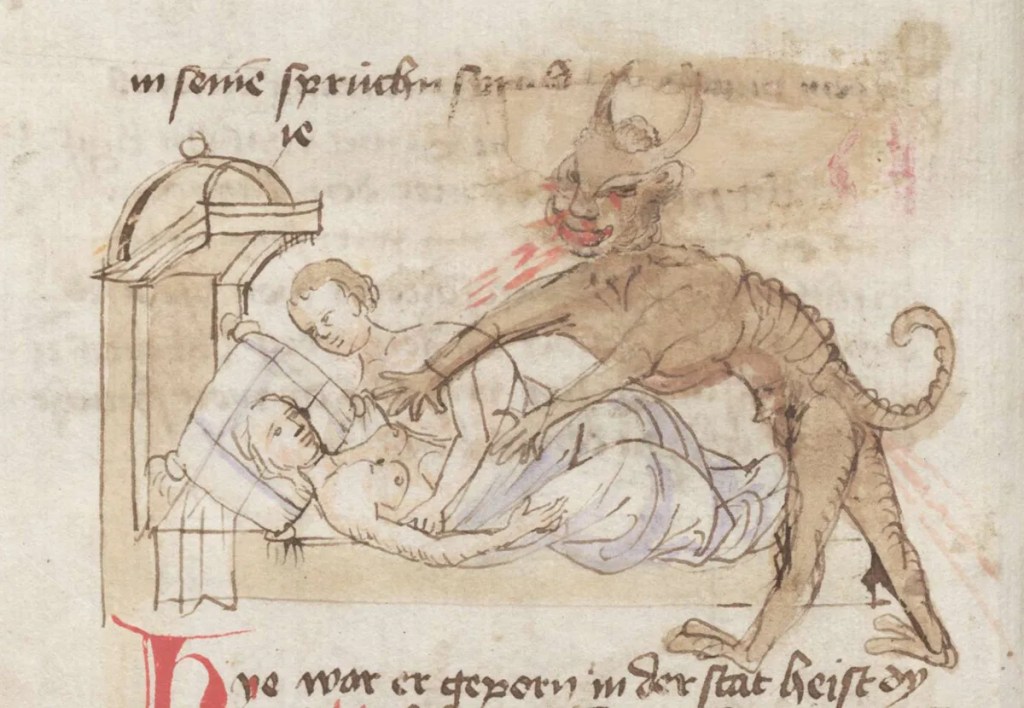
Step 1: All Daimones are fallen Angels
Augustine (City of God VIII.14-22, ca. 413-426 CE) systematized the position: all pagan daimones, including Plato’s intermediary spirits, were in fact demons, evil spirits who had rebelled against the Christian God and now worked to deceive and corrupt human beings.
With Christians we did indeed see a flattening of spirituality. ‘Good’ Pagan Daimons that brought you closer to God would, if they were lucky, be reclassified or thought of as angels. The rest were demonic. There was a lot of argument about how they may classify Socrates’ Daimonion; be it something like a guardian angel, or something more Demonic? Here we see Augustine who, despite having a lot of respect for Plato’s and Socrates’ philosophy and agreeing with it on several points…
This is why we rate the Platonists above the rest of the philosophers. The others have employed their talents and concentrated their interests on the investigation of the causes of things… while the Platonists, coming to a knowledge of God, have found the cause of the organized universe, the light by which truth is perceived, and the spring which offers the drink of felicity.
…was still highly skeptical of this supposed intermediate spirit. Why would these spirits be in the employ of a good God if we could not definitively say they are good? Certainly they aren’t if they suffer the same passions, anger, lust, etc. of men. If there was such a good spirit acting as a messenger or intermediary of God, it would be an angel. The rest? Why would a flawed and inconsistent being act as the go-between? They must be evil, and must not fill that intermediate role. A role better filled by the angels and by Jesus. He attacked Apuleius’ God of Socrates on these grounds.
It is worth pointing out that Platonism very much set the stage for this shift towards monotheism. The Grecian pantheon was being demonized by Plato and Socrates themselves well before Augustine got his hands on polytheism. Given the rise of Christendom this was an unfortunately sensible next step in the religion’s rise to power.
Was it fair and right to the polytheists? I don’t think so. It was certainly not nuanced. Does that make it theological hijacking? If a disagreement on spiritual cosmology that fundamentally must exist due to the creation of a monotheistic religion is hijacking, then yes. But it is also fair to point out that this is very much consistent with their new belief system, and was a natural step towards their goals.
It resonated because they had a point within their systems; the mythological Greek Gods and Apuleius’ definition of the Daimon, nuanced in their behavior and very much individual, were not God or Godly. Not to the Christians nor to Plato and Socrates. A monotheist would not be expected to give appropriate reverence to other gods, especially if they were characterized in the way the Greek ones were. It would have certainly been better had they treated the polytheistic systems with more respect and less disdain, but that was not on the agenda.
Step 2
The sexual act itself became the vehicle of damnation.
I wanted to pull this particular piece of the pie out for examination. I actually talked a good deal about passion in this blog post, written while I was still blissfully unaware of this terrible article. Christians did join in on the consensus that sex had its proper place in Marriage. Marriage was important to the Greeks as a civic institution that helped assure legitimacy, but were far more liberal about sexuality outside of the marriage bond (for men).
The church’s distaste towards sexual passion did continue and grow over time, even when it ceased to serve the practical purpose it did during the middle ages. Nowadays it is less about legitimacy and more about the sacred meaning the marital bond carries, and how your decision about the use of sex determines its morality.
This, however, was never a condemnation of sex itself. To the author’s credit, he does seem to understand this to some degree based on other things he says within this section, which is why making this claim in the first place is odd.
Sex was to be done within its proper place. While folk tales did warn about the effects of romantic and sexual passion, it was never sex in a vacuum that brought about ill ends. It was lust and devilish sexual desires that led to these ends, often outside of the marriage bond (though for Christians, sometimes within it as well. The Devil can tempt you in mysterious places).
I also want to point out that this does not mean that the Christians are against sexual pleasure within marriage. Just that they were, and are, very wary of lust and strong sexual passion and desire both within and without marriage. They recognize that sex itself allows for bonding, joy, and comfort. Sex is not evil to them, its misuse is.
Step 3: If Sexuality Is Demonic, Demons Must Be Sexual.
The logic is circular but inevitable. If sexuality is the domain of evil, and demons are the agents of evil, then demons must operate through sexuality. The incubus and succubus are the logical products of this reasoning.
The author claims it is sexuality itself that is seen as demonic here, which as we’ve discussed is a mis-step. It is not a point that follows directly from statements he made within his second step.
Succubi and Incubi are evil to the church because of their connection to sexual passion and lust, not their connection to sex itself. If sex itself was evil, then humanity would wholesale be evil, as the ability to have sex is baked in to almost every single one of us. There is not a war on sexuality itself, there was a war on passion. The molestations of the succubi and incubi in church myth are categorically different than the church’s version of healthy sex.
We can object to the church’s war on passion. I certainly have, and my relationship itself is an objection. But this is categorically different than a war on sex.
A 13th century theologian, widely regarded as the greatest intellect of medieval Christendom, devoted serious scholarly attention to the question of how demons transport semen between human beings.
He then attempts to shit on Aquinas for commenting on how a succubus and incubus may reproduce, in the section where Aquinas explores whether angels have bodies, whether they assume these bodies, and how those bodies may or may not operate.
The ‘serious scholarly attention’ to succubi is but a small section of a much larger discussion, and his belief is that since these spiritual beings lack bodies, if they were to reproduce with humans, they’d have to take form, steal their seed, bring it to a woman, insert the seed, and beget a person (not a demon).
This is consistent with his views on spiritual and angelic beings, and steps away from the idea of demons having constant bodies of air (instead they are purely spiritual beings that form these bodies to interact with humans temporarily, like angels). He is not outwardly stating that this must be something that happens, just that it was reported enough to require comment, and that these would be the mechanics of it were it to be true.
I naturally disagree with Aquinas as to the mechanics of spiritual reproduction here (a major point here is that he basically does not believe such a spirit could reproduce, and certainly not with a human), but that’s beside the point. It is consistent with his beliefs about what demons may have been at the time.
Aquinas: Still if some are occasionally begotten from demons, it is not from the seed of such demons, nor from their assumed bodies, but from the seed of men taken for the purpose; as when the demon assumes first the form of a woman, and afterwards of a man; just as they take the seed of other things for other generating purposes, as Augustine says (De Trin. iii), so that the person born is not the child of a demon, but of a man.
So far we have established that a spirit lover can have a place within these understandings of the world. These questions aren’t just questions of wet dreams, sleep paralysis, and other convenient anti-scientific excuses, but real explorations about whether or not a spiritual being would experience lust for a human, and how they might engage with that within the author’s own system. Or perhaps that they desire to deceive us and bring us into sin by pulling at our own weaknesses, if you’re more Christian inclined.
The point is not that these specific views on spirit lovers are correct, but that the conceptions of these thinkers did include them or have space to include them, and that when they were included they were included for reasons that were reasonable at the time. These are only some of the ways the stage for the spirit lover was set across history.
Section 4: The Mask Slips
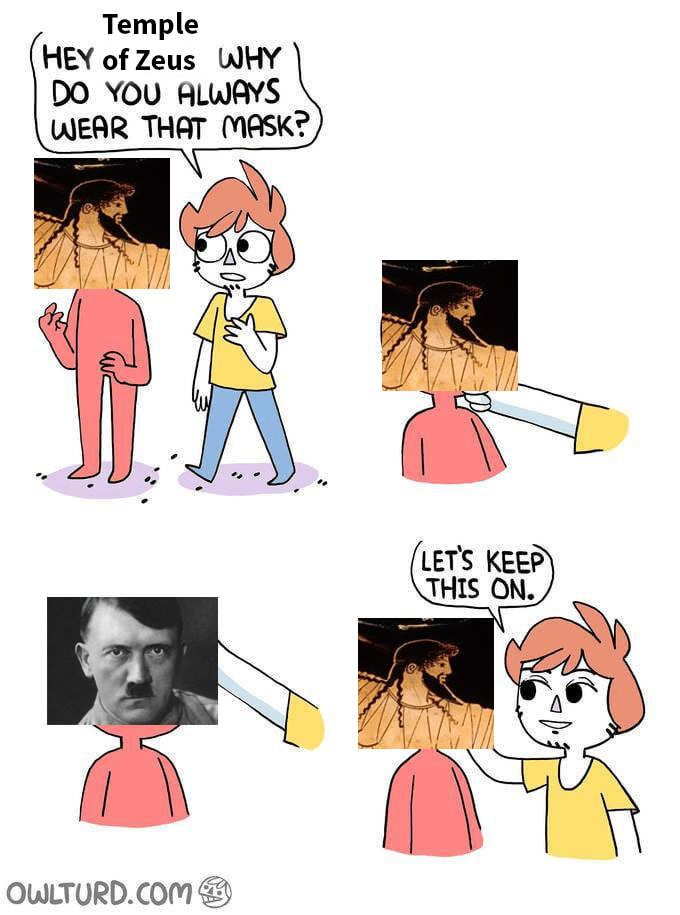
Up until this point, you may have been wondering why the author would decide to take this stance in the first place. After all, even if it is their personal belief that it is true, it’s not really an important thing to cover. The article itself has made some flawed arguments and doesn’t really consider every angle that it probably should, but that by itself isn’t really a big deal.
As we begin to see going forward, the article will take a turn for the worst. The author’s disdain for Jews is on full display in these next sections.
Lilith, in the Hebrew Bible, is a desert animal or an atmospheric spirit. She is not a seductress, not a collector of semen, not a succubus.
It is clear that the Lilith we have today is mostly a medieval creation that was eventually popularized by Feminism. I don’t believe that was ever up for dispute. The European Succubus and Incubus are also medieval creations. As outlined, I don’t see this creation as illogical in the same way the author does.
Further, we don’t have the full scale of this ancient mythology within our hands. We can look to the Lilitu and ardat lili themselves, and her mythology also seems to have taken from Lamashtu. But it is hard to definitively see every thing that Lilith may have been pulling from, simply because we have limited information before the Talmudic take on the character.
For a much fairer interpretation of the development of the character of Lilith and these events, I have provided the full section on Lilith from an archived copy of “The Encyclopedia of Jewish Myth, Magic, and Mysticism” by Rabbi Geoffrey W. Dennis. I own the first edition, this comes from the second.
TL;DR: she is far more than a demon that causes nocturnal emissions. I have included the writeup within the arrow, as it is pretty long.
Lilith: (Lilit). “Night [Demon].” Now regarded in Jewish lore to be the most prominent of the four queens of demons, the nature of Lilith has undergone many reinterpretations throughout Jewish history. The origins of Lilith are probably found in the Mesopotamian lilu, or “aerial spirit.” Some features of Lilith in Jewish tradition also resemble those of Lamashtu, a Babylonian demoness who causes infant death. There is one mention of lilot (pl.) in the Bible (Isa. 34:14), but references to Lilith demons only become common in post-biblical Jewish sources. Furthermore, the characterization of Lilith as a named demonic personality really only begins late in antiquity. The Dead Sea Scrolls (Song of the Sage 4Q510—11), speak of lilot as a class of demonic beings:
And I the Sage declare the grandeur of His radiance in order to frighten and terri[fy] all the spirits and ravaging angels and the bastard spirits, demons, liliths, owls and [jackals] and those who strike unexpectedly … 1
This assumption of multiple lilot is replicated in amulets and magical formulae well into the medieval period. Even the gender of the creature is not fixed. incantation bowls, for example, explicitly protect against “lilot, whether male or female …”
In time, what eventually emerges from these biblical and medicinal magical traditions is three overlapping interpretations of Lilith: the etiological Lilith, a spirit that accounts for certain common but puzzling human physical processes— Death in childbirth, sudden infant death, and male nocturnal emissions; the Midrashic Lilith, a creature born out of the medieval interpretation of problematic biblical passages; and the cosmic Lilith, an entity described in esoteric texts that personifies the existence of evil in the divine order.
Jewish tradition gradually fixes on Lilith as a female demon. In Talmud and Midrash, she is described as a demon with a woman’s face, long hair, and wings (Nid. 24b; Eruv. 100b). She is a succubus, seducing men in their sleep and then collecting their nocturnal emissions in order to breed demonic offspring (Shab. 151b; Gen. R. 18:14). Later commentaries on the Talmud explain Lilith does this because her consort, Samael, has been castrated by God. She has many demonic children, the most famous being Ormuzd (B.B. 73b). In amulet incantations contemporary to the Talmud, she is addressed as a demon that preys on women in childbirth and as the spirit of infanticide, the killer of children, a theme that become more prominent in medieval sources (Zohar I:148a—b; Zohar I:267b).
The use of “Lilith” as the proper name of a specific demonic personality first gets solidified in the Midrash. The most famous legend of Lilith is the one first appearing in the medieval satirical text Alef-Bet of Ben Sira. In that document, Lilith is identified as the first woman God created along with Adam. The case for there having been two women in the Garden of Eden is based on the two disparate accounts of the creation of woman that appear in Genesis (Gen. 1:27 versus Gen. 2:18—23):
He created a woman for Adam, from the earth, as He had created Adam himself, and called her Lilith. Adam and Lilith began to fight. She said, “T will not lie below,” and he said, “I will not lie beneath you, but only on top. For you are fit only to be in the bottom position, while am to be in the superior one.” Lilith responded, “We are equal to each other inasmuch as we were both created from the earth.” But they would not listen to one another. When Lilith saw this, she pronounced the Ineffable Name and flew away into the air. Adam stood in prayer before his Creator: “Sovereign of the universe!” he said, “The woman you gave me has run away.” At once, the Holy One, blessed be He, sent these three angels to bring her back.
Said the Holy One to Adam, “If she agrees to come back, fine. If not she must permit one hundred of her children to die every day.” The angels left God and pursued Lilith, whom they overtook in the midst of the sea, in the mighty waters wherein the Egyptians were destined to drown. They told her God’s word, but she did not wish to return. The angels said, “We shall drown you in the sea.”
“Leave me!” she said. “I was created only to cause sickness to infants. If the infant is male, I have dominion over him for eight days after his birth, and if female, for twenty days.”
When the angels heard Lilith’s words, they insisted she go back. But she swore to them by the name of the living and eternal God: “Whenever I see you or your names or your forms in an amulet, I will have no power over that infant.” She also agreed to have one hundred of her children die every day. Accordingly, every day one hundred demons perish, and for the same reason, we write the angels’ names on the amulets of young children. When Lilith sees their names, she remembers her oath, and the child recovers.”
This account, incidentally, is a Jewish variation of a story about a demon curbed by three pursuers that also appears in Greek, Coptic, Arabic, Armenian, and Slavonic legends. This midrashic version of Lilith’s origins proves to have only a minor influence of traditional Jewish thinking, eventually getting integrated into amulets as part of the etiological tradition in Sefer Raziel, but only really achieving wide-spread circulation in the modern era, with the printed re-publication of ABBS.
Lilith appears in a third and very different incarnation in the highly influential Treatise of the Left Emanation, written in the 13th century by the Kabbalist Isaac Cohen, where she is portrayed as the evil antipode to Eve, and the female personification of cosmic evil, the consort and mother of princely demons:
[I]t is made clear that Samael and Lilith were born as one, similar to the form of Adam and Eve who were also born as one, reflecting what is above. This is the account of Lilith which was received by the Sages in the Secret Knowledge of the Palaces. The Matron Lilith is the mate of Samael. Both of them were born at the same hour in the image of Adam and Eve, intertwined in each other … You already know that evil Samael and wicked Lilith are like a sexual pair who, by means of an intermediary, receive an evil and wicked emanation from one and emanate to the other … The heavenly serpent is a blind prince, the image of an intermediary between Samael and Lilith. Its name is Tanin’iver. The masters of tradition said that just as this serpent slithers without eyes, so the supernal serpent has the image of a spiritual form without color—these are “the eyes.” The traditionalists call it an eyeless creature, therefore its name is Tanin’iver. He is the bond, the accompaniment, and the union between Samael and Lilith. If he were created whole in the fullness of his emanation he would have destroyed the world in an instant.”
Lilith has a mount she rides, Tanin’iver, “blind dragon.” She can command hundreds of legions of demons. Intriguingly, the Treatise of the Left Emanation starts to come full circle, once again referring to multiple Liliths, as did the ancients. This tradition of there being two (or more) Liliths also appears in Pardes Rimmonim, and becomes a commonplace part of kabbalistic cosmology in 17th- and 18th-century works.
This interpretation of Lilith, as the female face of cosmic evil, also occupies a significant place in the Zohar, where she is the evil counterpart of the Shekhinah (II: 118a—b; III: 97a). There is also a tradition in the Zohar that Lilith was the Queen of Sheba who came to test Solomon.
In other, later mystic texts, she is one of the four queens, or the four mothers, of demons. She is the most prominent of the four, being queen of the forces of Sitra Achra, the impure, or left side of divine emanations, which run loose in the world. In the early modern Kabbalistic text, Emek ha-Melech, the three interpretations of Lilith put forth in earlier literatures are reconciled:
And all this ruination came about because Adam the first man coupled with Eve while she was in her menstrual impurity—this is the filth and the impure seed of the Serpent who mounted Eve before Adam mounted her … Behold, here it is before you: because of the sins of Adam the first man all the things mentioned came into being. For Evil Lilith, when she saw the greatness of his corruption, became strong in her husks, and came to Adam against his will, and became hot from him and bore him many demons and spirits and lilin (23b—d) … Samael is called the Slant Serpent, and Lilith is called the Tortuous Serpent (Isa 27:1). She seduces men to go in tortuous ways … And know that Lilith too will be killed. For the groomsman [Blind Dragon] who was between her and her husband [Samael] will swallow a lethal potion at a future time, from the hands of the Prince of Power. For then, when he rises up, Gabriel and Michael will join forces to subdue and bring low the government of evil which will be in heaven and earth. (84d)
Defenses against Lilith include providing amulets inscribed with the angelic names Sanoi, Sansanoi, and Samnaglof (or Sandalfon) (Sefer Raziel, Illustration) to women in childbirth and to newborns, not sleeping alone in a house, and tapping an infant on the nose if he appears to be responding to something the parent cannot see. psalms, particularly Psalms 16, 91, 121, and 126, are effective in driving off Lilith (Shimmush Tehillim, 121, 126).
There is also a ritual that can be performed during and after intercourse to drive her away (Zohar III:19). German Jews of the 18th century had a more elaborate ritual, involving the new mother sleeping with a sword, dagger, or sword-shaped charm under her pillow and arising each night for the first thirty-one nights to slash the air around the bed (assuming the child slept in the bed with her) to fend off the threat.
In modern times, inspired by the singular Ben Sira portrayal of her as a woman who stands up to male domination, Lilith has become a rallying point among feminists in critiquing the overwhelmingly male-oriented perspective of traditional Judaism, and she has been adopted as a symbol of feminist resistance to male spiritual hegemony.
It should be pointed out, however, that modern claims that Lilith was an early Hebrew goddess later censored out of the tradition by the authors of the Scriptures has no basis whatsoever in the historical record. This claim appears to depend entirely on appealing to the Ben Sira narrative, but that story is sui generis (Note: this basically means ‘its own thing’), and there is no precedent for any belief in Lilith as either “Wife of Adam” or “Wife of YHVH” prior to the 10th century CE.’
Dennis, G. W. (2016). Chater L, lilith entry. In The Encyclopedia of Jewish Myth, Magic, and Mysticism (Second, pp. 439–443). Llewellyn Publications.
The author contains many citations within this section. If you’re interested in further reading, it’s probably worth looking at those. Link to Archive Here
I recommend buying the book if you’re interested in more, it’s great to have on hand. I wish I had the second edition and not the first. Note the page numbers used are from the archive, and will likely line up different with a physical copy.
But the logic is clear enough: the rabbis needed an explanation for nocturnal emissions that did not implicate the dreamer in sin.
Spirits and Gods were used to explain all sorts of things over history. Our understanding of the human body has grown since then, so we know it’s not a spirit like a lilitu causing things like illnesses. We also know that the Gods aren’t the ones sending storms or droughts or locusts our way. We also now know that Lilith isn’t the one causing wet dreams or the death of infants. As an aside, it seems that all the other things she and succubi were said to cause or represent were conveniently left out of this article in favor of nocturnal emissions.
A Rabbi trying to understand this without modern day knowledge and acting within his own religious framework could come to such a conclusion. That does not make him stupid. There were and are many approaches to the idea of intercourse between a spiritual being and a human, and this is just one of them. They are far from the only culture that came to these conceptions of demons of the night.
Furthermore, does the time a concept was created cheapen the value of that concept? I’ve talked a little about my conception of Lilith and Naamah before, and that conception has changed some since I wrote that blogpost. Is Lilith illegitimate as a spirit, demon, deity, or whatever you may refer to her as because she was created in her current form during the middle ages? Is Greek mythology less legitimate because other mythologies existed before it? Obviously not. The mythological Lilith created in the middle ages can be said to be as legitimate as Zeus is, or as the Lilitu are, or as succubi and fairies are, etc. Certainly the myth is no more or less relevant because it came later.
…It is in fact the documented fantasy of sexually repressed men, written in an era when rabbinic scholars were forbidden to look at women, forbidden to touch women outside of marriage, forbidden to experience sexual arousal without guilt, and yet biologically incapable of stopping nocturnal emissions.
As established above, Lilith is a much richer and fully formed character than ‘just a documented fantasy based on sexual repression’. This section also levels the idea that Rabbis are sexually repressed men. It’d be one thing if this kind of accusation was leveled towards the Christian monks. But Rabbis?
1) It is a mitzvah for a husband and wife to love each other and share intimacy. (Genesis 2:24) [I probably don’t have to explain what cleaving onto one’s Wife means. Marital sex and arousal is a good thing, not a bad one].
2) It is a mitzvah for a man to fulfill his wife’s sexual needs. (Exodus 21:10) [Women have Marital rights, including sexual needs. Those needs include sexual satisfaction from their husband]
3) Additionally, if there is a chance of procreation, it is a mitzvah to “be fruitful and multiply.” (Genesis 1:28) [I Probably don’t need to explain this one]
They’ve long been enjoying themselves guilt-free.
Section 5: The Jewish Sinbad

In which the author shits on Judaism for mythological stories. He opens with a reference to some of the stories within the ‘Jewish Sinbad’.
…Even within the rabbinic world, these tales were recognized as fantastical to the point of absurdity. Later commentators (the Vilna Gaon, Rav Kook, Maharsha) insisted they were allegories, but the plain reading is clear enough: these are tall tales produced by a scholarly class that had lost contact with the physical world and compensated with increasingly elaborate supernatural mythologies.
The quotation refutes itself. Jewish thought leaders defined and continue to define these stories as allegories and teaching stories that are entertaining and sometimes carry deeper meaning.
Would it not sound absurd if I was like ‘Ah, those stupid Hellenists, believing in a bull headed monster guarding a labyrinth, and that we can fly with Wax Wings. What fanciful bullshit, they’ve clearly lost contact with reality.’? It would, wouldn’t it. Judaism possesses a rich and layered mythology like many other religious systems do. Let the Jews have their myths and stories.
The broader pattern is significant. The same Talmudic culture that produced Lilith the succubus also produced stories about mermaid-like sea creatures, demonic offspring, and scholars who encountered supernatural beings on their travels.
Seems like pretty fun reading. I’d take it over any of the articles on the ToZ site any day, and I’ll need a palette cleanser after this abomination of an article. Jewish Sinbad it is! To be clear: The only person in the room taking these stories literally right now is you.
When this material merged with Christian demonology in the medieval period, the result was explosive. Christian theologians who already believed that all pagan spirits were fallen angels now had Jewish sources confirming that female demons attacked men sexually. The two traditions reinforced each other’s worst instincts, and the incubus-succubus mythology solidified into the form we know today: demons who visit humans at night for the purpose of sexual intercourse, draining their life force and corrupting their souls.
It is important to point out that even if succubi are intentionally an evolution of the lilim and Lilith, this is how mythology works. Different cultures trade ideas, stories, and myths. These are reinvented and re-applied within each other’s framework. They also change over time. This is something we’ve already seen with Lilith. Sometimes they even affect the framework itself. The Egyptian Khonsu is a fantastic example of this.
Medieval people needed ways to explain wet dreams, sleep paralysis, night terrors, infant mortality, and other things that medicine hadn’t caught up on. So a concept like a succubus makes sense, and if they found inspiration in the Jewish take on Lilith, then why not implement that? Several other cultures also invented their own succubus-esque spirits for all sorts of reasons, and many of those were taking from other cultures too.
I do have to wonder how seriously medieval Christians would take a Jew on the subject though. Jews weren’t exactly well liked by Christians back then, to put it extremely lightly. Honestly, you’d fit right in!
Section 6: The Assembly Line
The migration path from medieval demonology to modern occultism is direct and traceable.
The Malleus Maleficarum (1487), the infamous witch-hunting manual, devoted extensive sections to incubi and succubi. Heinrich Kramer, its author, was obsessed with female sexuality and convinced that witches copulated with demons. The Malleus was the bridge between theological speculation and judicial murder: real women were tortured and burned on the basis of this mythology.
Penczak puts it best when he outlines the following in his ‘Inner Temple of Witchcraft’:
Although not the first act of persecution, the publication of the Malleus Maleficarum served to fan the flames of these murders. This manual, called the Hammer of the Witches or the Witch’s Hammer, served as a supposed description of the Witch’s practices, how to hunt them, capture them, and elicit confessions using tests and tortures that few people could ever hope to resist. None of the material was based on actual Pagan practices, but on Christian doctrine and flights of the authors’ imagination and misogyny, although there is some speculation that the material was used by others as a manual to practice “Witchcraft,” including the Black Mass, a mockery and corruption of the Catholic Mass.
Penczak, C. (2021). The Inner Temple of Witchcraft: Magick, meditation, and Psychic Development. Llewellyn Publications.
It is unsurprising the Author includes the Malleus here in reference to spirit lover practice, understanding so little about spirit lovers and knowing of the Malleus as a satanist. This Christian fan fiction about witchcraft is not influential in almost any legitimate pagan practice. After all, if we believed the words it said, we would probably just be Christians.
Most of the legitimate Satanic witchcraft practitioners are not normally pulling from the Malleus either, and why would they be? It is he and he alone that believes the Christian definitions of succubus and incubus apply in any way to any spirit lover related practices that exist now and have existed in the past.
I also do not wish to discount the suffering of the pagans and ordinary people at the hands of the inquisitions. The burning times were a sad period in history.
The early modern grimoire tradition inherited the demonological framework. The Ars Goetia, the Pseudomonarchia Daemonum, and related texts catalogued 72 demons with specific powers and attributes, but notably did not assign any of them the function of sexual predation. The Goetic spirits were summoned for knowledge, treasure, military assistance, and political power. The “sex demon” remained a theological rather than a practical magical concept.
This statement is intentionally misleading in the same way that section 1 was. By narrowing the definition to ‘sexual predation’ (A Christian viewpoint of a succubus or incubus), he narrows the field so much that he can conveniently ignore several Goetic Demons, including:
(CLICK ARROW TO SEE)
Sallos: Romantic and Harmonious love moreso than lust specifically. Causes men and women to love each other.
Sitri: Lust, Romantic Passion, Sexual attraction! Well, in terms of inflaming men and women with love, anyway. Also can make people strip naked apparently.
Dantalion: A personal favorite of mine, and one I’ve encountered in my own spiritual experiences. Can cause love and influence thoughts and emotions. I tend to think of it as making you more persuasive in a very practical sense. The connection to love and sex is an obvious consequence.
Zepar: Causes women to love men, and brings them together.
Beleth: Can bind both men and women in obsessive love until the Conjurer is satisfied. Sounds a bit rude honestly.
Gremory: Gemori? Gemory? Whatever, there are a billion ways to spell this. Often thought of as a woman, including by myself due to how they appear, even though it’s ‘Duke’ Gremory. Provides insight to the matters of the heart, brings out the love of women, and helps Anthony become a less shit human being in Shin Megami Tensei: Strange Journey. Also a boss in the bloodstained series of games. Yeah, they’re very popular.
Vual: Also lots of ways to spell his name. Does a lot of things, including procuring the love of women.
The Left Hand Path traditions of the 19th and 20th centuries absorbed the incubus-succubus mythology through three channels. First, through the “Satanic” inversion of Christianity, which accepted the Christian demonological framework wholesale and simply reversed the moral polarity (what Christianity called evil, these movements called liberating). Second, through Aleister Crowley and the Thelemic tradition, which treated sexual magic as a genuine spiritual technology and borrowed freely from both grimoire demonology and Kabbalistic imagery. Third, through popular occultism and horror fiction, which found the “sex demon” commercially profitable and psychologically compelling.
I don’t think the ‘satanic inversions of Christianity’ are a quarter as influential as you’d hope they were. That aside, Crowley had little to do with the propagation of the succubus. He also certainly enjoyed his sex magick, something anyone would very quickly discover picking up and reading anything about the man. If he were to comment on succubi or incubi at all, he would not view them as demons in the same way that a Christian would. He also wouldn’t likely view them in the same way as I do.
Now, as we will see going forward, the author’s opinion is that sex itself has no place in magickal practice, which is why I think Crowley is included here. Let it be said that Crowley was a pretty shitty human being. But he wasn’t an idiot, and his practice of sex magick, while certainly self serving in his case, has a basis in real practice. Sex (including things like masturbation) is an exhibitory technique (which means it quickens the mind) and is useful in ritualism when we want to quicken the mind to reach a specific mental state. Its downfall is that it can be difficult to focus on the ritual when engaging in that kind of thing… Unless the ritual somehow relates back to a sexual idea. The symbolism of sex is also useful for all sorts of ritual outcomes, which I won’t get into here.
And yes, the media is important for the development of culture. In fact it’s probably more responsible for the reinvention and propagation of the succubus than any magickal tradition was. It was certainly more responsible than Satanism and Crowley.
In fact, media and internet coverage of the succubus and spirit lover helped pull those concepts away from the biased and incorrect Christian definitions of such entities. Media and culture and myth and magickal practice changes over time, just as your JoS rebranded into ToZ. I suppose you’re okay with this as long as the change isn’t inspired by those icky Jews or Christians.
It’s also important to note that Spirit lovers have never been solely rooted in those things. No, our current spirit lover tradition is pulling at least as much if not moreso from other spirit relationship concepts, conceptions much closer to concepts like the Shamanic spirit spouse. Examples of spirit human relationships exist around the world (including in areas untouched by Christianity at the time). The succubus is popular, but the real relationships we engage in are of a very different nature to the Christian and Jewish mythology about succubi and Lilith. This should be obvious: if we believed in that mythology, we wouldn’t seek these relationships in the first place!
Section 7: The Author Tries to Convince me This is Harmful
First: It replaces real divine connection with masturbatory fantasy. A person who believes they are in a “relationship” with a succubus is not engaging with any spiritual reality.
This is wrong in two ways. The first is obviously that the author claims that this experience doesn’t exist and is a self inflicted fantasy. Even if we accepted that the author is correct and that these relationships are a fantasy, this statement is also wrong because it implies that engaging in a fantasy makes real divine connection impossible.
These things are not mutually exclusive. You can have a genuine connection to divinity, and also have (or in the author’s opinion, make up) a spirit lover. In fact, the idea of union, of 2 into 1, of parts into the whole, within sex (whether human sex or our brand of it) draws a person towards divinity very explicitly. If anything, partaking in a loving sexual relationship with a spirit lover or a human is one of many pathways towards divinity. Even were it imagined, the concepts the relationship draws on remain and can uplift in the same way. A misuse of sex could be distracting, but sex within these relationships is far from misuse.
Second: It trains the practitioner to associate spiritual experience with sexual arousal. This conditioning is the exact opposite of what genuine spiritual practice does.
The author seems to be of the opinion that a person in a deep relationship with a spirit can not possibly experience spirituality in a non sexual way, and that if he does, he’ll only recognize it if it is sexual arousal. This is in spite of the fact that said spirits also give us a wide range of alternative experiences outside of sexual arousal.
It should also be obvious that the sum total of our spiritual experiences are not only our spirit lovers. I have a spirit lover. I can also go cast a circle, call quarters, perform an LBRP, help facilitate a public Samhain ritual, join a witchcraft class, and have all kinds of personal spiritual experiences in all kinds of other areas.
What this sounds like to me is that the author is vehemently denying that sexual arousal can be a part of a spiritual experience just as much as many other things are. Sexual arousal can be and often is a part of rituals, magickal practice, spirituality, and spiritual experiences. This is not disputable without discounting so many aspects of spiritual practice that we reach an area as narrow as his misdirection in section 1. Sexual arousal is one of a multitude of powerful feelings the human body and mind can experience when engaging in spiritual practice (and not just with spirit lovers!).
Third: It creates dependency on a fantasy. Practitioners who “develop relationships” with succubus entities frequently report emotional attachment, jealousy, inability to form human relationships, social isolation, and psychological disturbance.
The first part of this assumes his previous argument is true, so I can safely ignore the dependency on fantasy idea. I’m also unsure where these practitioners that are supporting his conception that these relationships have overwhelmingly negative outcomes are. They weren’t on the forum. They’re not in my comments. They weren’t in the discord server when that was around, and there were over a thousand of us there. They aren’t the other bloggers that talk about this subject. The only source I could imagine him using besides his own audience is YourGhostStories or some similar nonsense.
People who are in long term relationships with spirit lovers almost universally report positive and healthy experiences. Exceptions do exist, and I do not wish to discount those; relationships of all kinds can go wrong. However, practitioners that have engaged and continue to engage in these long term spirit lover relationships almost entirely provide highly positive reports.
Emotional attachment and jealousy (from the human and the spirit), are very normal hallmarks of a relationship (and normal human romantic relationships as well). People in these relationships are also fully capable of having human relationships and not being socially isolated. The idea that we are a bunch of social loners that are incapable of genuine human relationships and connection is incorrect and biased.
There may be a small number of practitioners that are socially isolated and have issues forming human relationships that turn to spirit lovers to fill that hole. In such cases the spirit lover is not and has never been the cause; that relationship is simply an attempt to treat the symptoms. These are also the minority, and these are things this minority can overcome regardless of their spirit lover. The spirit lover itself will often even push them in that direction if it believes it is beneficial.
This argument on the author’s part also betrays that on some level he understands that his conception of the succubus relationship is incorrect. If succubi are just Christian sex monsters driven entirely by lust, they or the humans involved wouldn’t be forming relationships, or jealous, or emotionally attached. All parties involved just have their sex and end it there. There is acknowledgement here that succubi aren’t the imaginary sex addicts the author has pretended they are the entire time, and are instead much broader and more complex entities.
The spiritual harm is real: time, energy, and psychic attention that could have been directed toward genuine growth are consumed by an elaborate performance that produces nothing except increasingly detached internal experience.
This was touched on in step 2. There is opportunity cost no matter what we choose to do. That is the nature of time. Is only a narrow subset of practice a legitimate way to pursue spirituality? Obviously not. Is his approach to practice better for you or for me? That is up to us to decide. To these kinds of sentiments, I must always declare this: Who are you to determine what practice best serves me?
His characterization of these relationships as producing nothing other than detached internal experience is also ridiculous. I have experienced a cornucopia of genuine growth from the assistance of my spirit lover. This is in addition to the romantic and sexual dimensions of the experience. Many other people have. They challenge us for our own good as quickly as they make love to us.
Fourth: It perpetuates the Christian demonization of the Gods. Every person who “summons a succubus” and treats it as a “demon” is operating within the Christian theological framework, whether they realize it or not.
No, actually, accepting that we can have positive long term romantic relationships with spirits (succubi included) is in clear defiance to the Christian demonization of spirits. Even if we were only after sexual relationships, the singular belief that this could be good and healthy is in clear objection to the Christian conception of these relationships and the Christian conception of sexual desire as a whole. Your fallacy is in taking a Christian definition of the succubus and incubus (concepts you also simultaneously claim are fake), and using that to inform your beliefs about what succubi and incubi, and spirit lovers at large, actually are. The only one working within the Christian framework here is You within this article.
Section 8: Making Zevism Fit

I don’t care very much about most of this section. If the ToZ dislikes this kind of practice, it doesn’t really matter. They can practice their beliefs as they see fit. It is not to me to determine what practice best suits them. Though I find some of the points and certainly the theming a little weird considering the clear love of Plato.
If he wants to reject sexuality and spirit lovers within his magickal system, let him. I couldn’t care less, even if I think it’s a weird decision. If that was his only point this article wouldn’t exist. But that’s very different than trying to paint a picture of what Christians, Jews, other practitioners, and everyone that has a relationship with a spirit lover including myself, believes and experiences.
In general, his religion also comes off as very confused based on this article. At the very least they’re not trying to be anti-Abrahamic Neo-Nazis while outwardly declaring themselves satanists anymore. I mean, they still are satanists, they really just gave themselves a facelift.
The point of this blog post isn’t to dig into whether Zevism is a legitimate religion or not. It is to answer the charges made against the concept of a spirit lover. However, there are beliefs that appear in this article that make Zevism seem very confused as a system, and the whole of the article seems poorly researched and narrow. If this auxiliary article is reflective of the standard of the beliefs that Zevism is founded upon then that is not a good sign for the religion.
Conclusion: A Narrow and Worthless Article
What frustrates me about this content the most is its intentional design. At points the author is intentionally narrow. At others he draws on Christian ideas to cast the succubus in a specific light, while also denouncing the sources he relies on to paint a picture of an entity that allegedly doesn’t exist. Half of this piece is designed to make Christians and Jews look like the enemy. Inconvenient mythology and reference is ignored or written around to make the author’s position look more legitimate than it actually is.
The author is attempting to paint a picture here. Of braindead and remorseless Abrahamic religions, tearing down the pagan gods. Of stupid theologians, mis-using the works of Plato. Of Zeus as… actually, it’s not entirely clear. What is he supposed to be here, exactly? Besides Satan and the dozens of other Gods you say are also him, because I guess it’s okay to appropriate and recontextualize the deities of other religions when you do it.
The most amazing thing about this article is that it just kept getting worse the more I read and researched. What started as an already fairly length blogpost only got lengthier and lengthier the more I dug into the material. I would rest one evening thinking I was almost finished before digging into another question that occurred to me as I woke up the next day. This article is shoddy, unfair, baseless, biased, and in many ways just flat out wrong.
Let us end on a positive note: Examples of entities and practices where the spirit spouse or lover exists outside of the succubus. Our practice pulls on ideas from many great traditions, several of which I’d like to eventually become more familiar with. I’m ignoring the Greek here. I think we’ve already looked at enough Greek.
Included Here are some other entities and practices aside from the succubus that we may see.
- A bunch of different entities and concepts are named within the first chapter of Sexual Alchemy. Some of these are better representative of the source material than others. Tyson has a tendency to be self-serving when it benefits his argument, at least within this book, so be careful about taking him at his word. For a similar reason I’m leaving out concepts such as the ‘brides of Christ’ here.
- We already mentioned it, but certain Mesopotamian Demons and Ardat Lili in particular, eventually conglomerating into the Jewish Lilith.
- The Shamanic Ayami in many traditions. A lot of the ways we often think about spirit lovers overlap here; They initiate the shaman into the tradition and form an intense and romantic bond that requires fidelity.
- In some stories, Chinese fox spirits that seem to be called ‘Huli Jing’ would form intense romantic bonds with humans, appearing as a beautiful woman. In some but not all cases this had some predatory overlap with the succubus. In many, the spirit is said to be fiercely loyal. This characterization seems to be based on specific stories (Pu Songling from my research). The term Huli jing is apparently still used today as an insult against women who steal away husbands.
- The Blolo Bla: The Baule seem to believe that everyone has a spirit spouse on the other side, known as the Blolo Bla (or its masculine name, Blolo Bian). This relationship seems not to be intended as sexual, as the spouses help ease marital stress and bring good fortune and seem to act more like a guardian of the home.
- Islamic Jinn Marriage: The attitude of the Islamic scholars in regards to this is similar to the Christian attitude towards the succubus. These spiritual ‘possessions’ or attachments were at their mildest but still often overwhelming when the Jinn was simply in love. According to Ibn Taymiya, these situations happened all the time, and he claimed he had witnessed them several times.
- European Fairies. Tons of stories about those relationships with strange women. They weren’t predatory in these cases (or at least they weren’t in the ones I know of), but the nature of the relationship often led to an ill outcome, as you’d expect during this Christian era.
- Kitsunes. The stories have something in common with the idea of the European fairy concept; devoted and fiercely loyal, but forced to leave once the husband discovers their fox nature. Rafe’s favorite (Rafe is the asuccubuslovesme blogger, whose blog is currently gone, and my friend).
And many more! The subject is honestly fascinating, whether you’re focusing on predatory spirits more akin to the child eaters and blood suckers, or the more positive spirit spouses.
An extraordinarily sincere thank you for anyone who stuck with me through this examination. I am very passionate about these relationships, and while I certainly accept that some people will not see them in a positive light, I have to draw the line at what I see as intentional misdirection and obfuscation. I know this blogpost was extremely and perhaps needlessly long. Thank you for taking the time to read it anyway.
Next time I intend to write something that is far more entertaining than this examination, and less long. I don’t plan on engaging with this author or Zevism any further.

 Spirit Lover Information Hub
Leave a comment